Is Geranium Oil Adulterated? How Labs Tell
If you have ever wondered whether the geranium oil you are holding is exactly what the label says, you are in good company, and the answer is not found in your nose or your wallet. Smell and price are useful clues, but neither can confirm what is in the bottle. A laboratory can, and knowing what each kind of adulteration leaves behind makes it much easier to ask a supplier the right questions.
Rose Geranium Essential Oil
Our own Rose Geranium Essential Oil, in sizes from 0.5 oz to bulk.
From $24.99
Shop Now →Three ways an oil can be stretched
The analytical literature describes three broad routes. A cheaper essential oil can be blended in, a synthetic or isolated compound can be added to prop up a profile, or the oil can be diluted with a vegetable oil. Each leaves its own trace. Blends and isolates show up in a full GC-MS profile and in chiral analysis, which separates mirror-image forms of molecules (cheap synthetics are often a mixture of both forms, where nature usually makes just one). Dilution with a vegetable oil is the sneaky one, because every volatile shrinks by the same fraction and the normalised percentages stay put, so only calibrated, absolute quantitation reveals it (Sadgrove et al., 2022; Capetti et al., 2021). Both are general reviews and case studies on other oils, so the geranium points below are reasoning from their methods and from geranium's published composition.
Why palmarosa comes up
The geranium literature most often links one oil to geranium on chemical grounds: palmarosa, a grass whose oil is rich in geraniol. IFRA's data list typical geraniol at about 82 percent in palmarosa and about 18 percent in geranium (IFRA, 2023). EFSA's specification lets geranium rose oil carry up to 18 percent geraniol, with five tested batches averaging 15 percent (EFSA, 2023).
The arithmetic is instructive. For a simple model, let palmarosa contribute geraniol at its typical 82 percent and none of the other main compounds: blending in only about 4 percent would carry an average oil to the top of that range, while citronellol, citronellyl formate and isomenthone would barely move. In other words, a check against a handful of range limits is not enough to rule out a modest blend. What gives the game away is everything a real geranium oil contains and palmarosa does not, such as the marker compounds the trade literature names: 10-epi-gamma-eudesmol in Egyptian oil and guaia-6,9-diene in Chinese oil (Tisserand Institute / ITC, 2015). A full report, with the supporting cast listed, is far harder to counterfeit than a three-line summary. If you want a walk-through of reading one, we have it in our GC-MS guide, and palmarosa versus geranium compares the two oils' scent and chemistry.
Geranium can be the adulterant, too
The relationship runs both ways. Because geranium is a far more affordable rosy oil, researchers have developed infrared methods to measure how much geranium oil, palmarosa oil or phenylethyl alcohol has been added to rose oil (Cebi, 2021). If you are choosing between the two for a rose-scented project, geranium versus rose otto sorts out what each brings.
What you can check at home
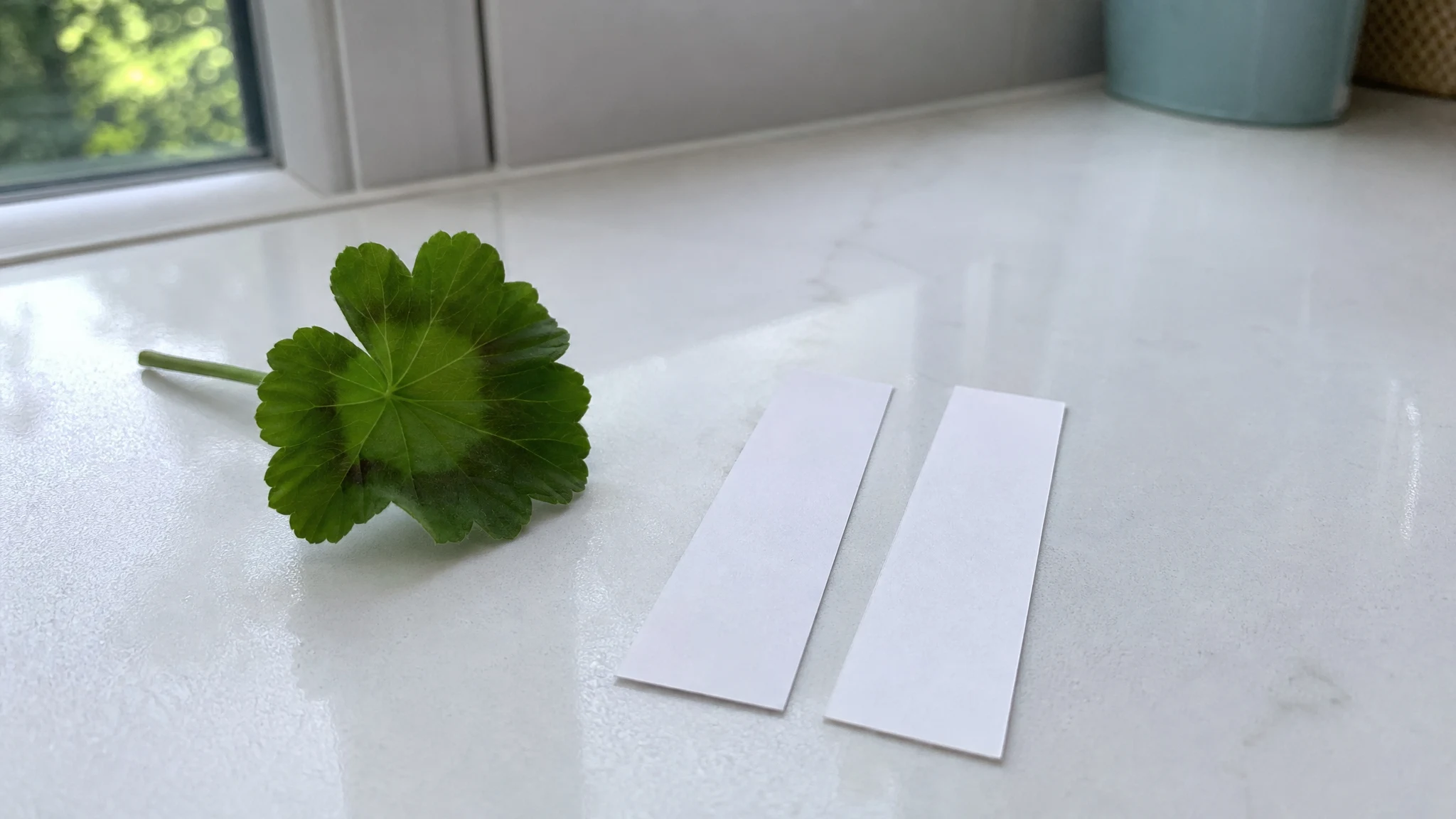
There is one home test with a published source behind it. Put a few drops on paper and warm it with a hair dryer for five minutes. A true essential oil evaporates, and a lingering greasy mark means some non-volatile material, such as a vegetable oil, was present (Sadgrove et al., 2022). It only addresses that one route, and it will not spot a blend or an added isolate. For everything else, treat smell and price as prompts for questions. The price article shows how the leaf arithmetic helps with that, and our buying guide covers the other checks.
Your nose is still useful, just not as a judge. Smell the oil fresh, then on a paper strip over an hour. Geranium oil is generally described as green and rosy with a minty edge, so an oil that smells one-note from start to finish is a reason to ask questions. It is a prompt, not a verdict, and it never replaces a report.
Keeping a paper trail
Keep every answer you get in one folder, together with the date, the lot number if there is one and the name of the person who replied. If you make products to sell, that folder can matter later, and it takes five minutes to keep tidy. A friendly, clear reply is a good sign; a vague one is worth noting too.
What to ask any seller, including us
A GC-MS report tied to your lot, with retention indices and the column named. Whether the figures are normalised area or calibrated mass. Chiral data with the natural reference range and where it came from, if authenticity is the worry. And the species or cultivar and country of origin, in writing.
The Certificate of Analysis we publish reports relative density and refractive index at 20 C for one batch. If you need more detail for your product, ask us in writing before ordering; the wholesale page offers sample bottles to evaluate in your own formulation, and a regulatory consultant is the right person for questions about labelling exposure. Buy on documents, and use your nose and the price to decide which questions to ask.
Nobody can verify an oil by nose alone, and nobody needs to. Ask good questions, keep the answers, and let the documents do the heavy lifting.
Rose Geranium Essential Oil
Rose Geranium Essential Oil from our own shop, in sizes from 0.5 oz to bulk.
From $24.99
Shop Now →Sources & Further Reading
- Sadgrove, Padilla-Gonzalez and Phumthum, 2022. Methods of Analysis and Authentication, Plants 11(6):789. pmc.ncbi.nlm.nih.gov/PMC8955314
- Capetti et al., 2021. Adulteration of Essential Oils, Molecules 26(18):5610. pmc.ncbi.nlm.nih.gov/PMC8471154
- EFSA FEEDAP Panel, 2023. Geranium rose oil, EFSA Journal 21(7):e08161. pmc.ncbi.nlm.nih.gov/PMC10373134
- IFRA, 2023. 51st Amendment, Annex on contributions from other sources. ifra annex xlsx
- Tisserand Institute (ITC Market Insider, 2015). Geranium oil history and cultivation. tisserandinstitute.org
- Cebi, 2021. ATR-FTIR quantification of geranium oil, palmarosa oil and phenylethyl alcohol in rose oil, Foods 10(8):1848. pmc.ncbi.nlm.nih.gov/PMC8391892