Geranium Oil Research: What the Studies Measured
Geranium oil has attracted a modest but interesting amount of research, and nearly all of it asks the same gentle question: can the scent of geranium make a stressful moment feel a little easier? The studies are small and early, and they were done with specific oils in specific settings, so they are best read as curious first chapters rather than conclusions. Here is what researchers have looked at, and how to read it sensibly.
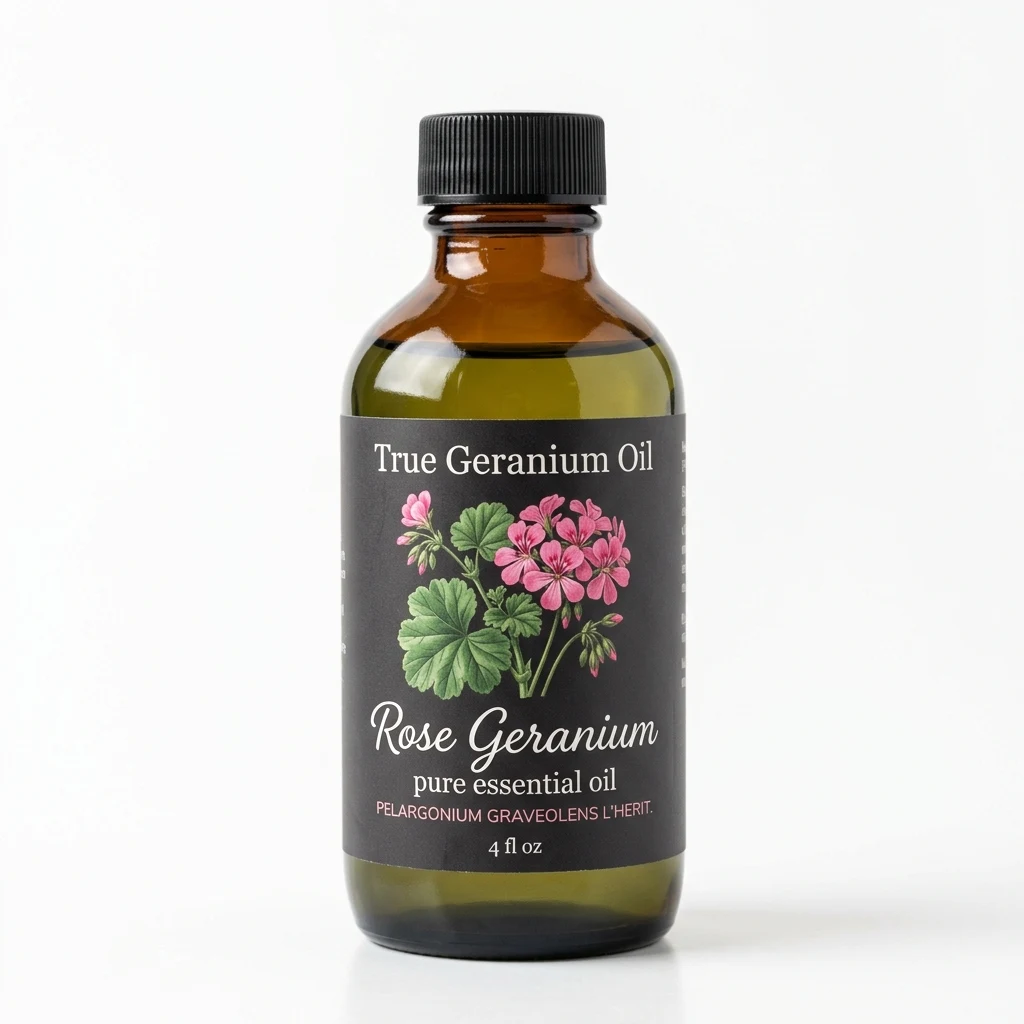
Rose Geranium Essential Oil
Our own Rose Geranium Essential Oil, in sizes from 0.5 oz to bulk.
From $24.99
Shop Now →Where researchers have looked
Most of the trials come from hospitals, where a drop or two of oil is easy to add to a routine. In one Iranian trial, 150 people waiting for hernia surgery were randomly given geranium aroma, music, or nothing, and anxiety scores in both the aroma and music groups ended up lower than in the group that got nothing (Explore, 2022). In another, 80 people on a cardiac ward inhaled three drops of geranium oil from a patch on an oxygen mask, or a placebo, for 20 minutes on two days, and the aroma group reported lower anxiety (Complement Ther Clin Pract, 2017). A trial of 153 people after gallbladder surgery compared lavender, geranium and no aroma and looked at pain and sleep scores (Akutay et al., 2026).
The same kind of question has been put to people at work. In a double-blind trial, 84 intensive care nurses inhaled one drop of Pelargonium graveolens oil or one drop of sunflower oil during three shifts, and the geranium group scored lower for fatigue, while sleep scores did not differ (Karimi et al., 2024). A different team gave 120 female students premenstrual massage with 2% geranium oil in almond oil, plain almond oil massage, or no treatment over eight weeks (Lotfipur-Rafsanjani et al., 2018).
Why these are early days
Reading these papers is a bit like reading the first reviews of a new restaurant: encouraging, but not the whole story. A few things are worth keeping in mind.
Scores are self-reported. Anxiety, fatigue and discomfort were rated by the participants themselves, and ratings like these respond to attention, expectation and the simple pleasure of a nice smell. That is why the placebo-controlled trials count for more than the ones with no comparison group.
Several comparisons cannot isolate the oil. In the massage trial, the students who had massage with plain almond oil improved too, so the touch itself clearly mattered, and the oil's own share is hard to pull apart. Music and a no-treatment group, in the hernia trial, cannot be hidden from the person receiving them.
The amounts are tiny and the oils differ. A drop or two near the face is a long way from a room filled by a diffuser, and "geranium oil" is not a single fixed composition. EFSA's specification for geranium rose oil gives ranges for its main compounds rather than single values (EFSA FEEDAP Panel, 2023), and the oils in these trials were not analysed against ours.
How to read the next headline
You will see new studies mentioned in the news and on social feeds, and a few easy questions will keep you grounded. Who took part, and how many of them? What was compared with what? How long did it last, and who did the rating? Was the oil in a room, on a mask, or on skin in a carrier? If a post cannot answer these, it is a slogan, not a summary.
It also helps to notice what a headline leaves out. A study of nurses on a hospital shift tells you about nurses on a hospital shift, and a study of one drop on a patch tells you about one drop on a patch. Neither is a recipe for your kitchen, and that is fine. Enjoying geranium for its scent needs no trial to justify it.
What this means for you
The fair summary is that geranium's aroma is interesting to researchers, and that bigger and better-controlled studies would tell us more. Nobody should read these trials as a promise about what any bottle will do. We sell our two geranium oils as external cosmetic and aroma oils, for scenting and for diluted skin care, so none of this describes what they do for your body. If you are dealing with anxiety, pain, sleep or period symptoms, your doctor or pharmacist is the right person to talk to.
The Certificate of Analysis we publish covers one batch and reports density and refractive index, so there is no constituent data we could hold up against a study. If you need a fuller analysis for your own product, ask us in writing before ordering.
Keeping it in proportion
It is tempting to treat any study as a verdict. A better habit is to treat it as one voice in a long conversation, and to wait until several careful voices agree before you repeat something as fact.
If you are curious about the next layer, there are three good places to go. Our post on hormones and geranium oil goes through the studies behind those claims, the myths post checks popular claims against their sources, and the chemistry post explains why the oil smells the way it does. For everyday practicalities, our safety guide covers dilution, and the Geranium Essential Oil page has the details of what we sell.
The studies are a good conversation starter and a poor sales pitch. Read them with curiosity, keep the claims modest, and let the rose-and-leaf scent speak for itself.
Rose Geranium Essential Oil
Rose Geranium Essential Oil from our own shop, in sizes from 0.5 oz to bulk.
From $24.99
Shop Now →Sources & Further Reading
- Explore (NY), 2022. Geranium aromatherapy and music therapy before inguinal hernia surgery. europepmc.org/MED/32888828
- Complement Ther Clin Pract, 2017. Geranium aroma and anxiety in acute myocardial infarction. europepmc.org/MED/29122262
- Akutay et al., 2026. Aromatherapy after laparoscopic cholecystectomy. europepmc.org/MED/40490599
- Karimi et al., 2024. Pelargonium graveolens aromatherapy, fatigue and sleep in ICU nurses. Explore (NY) 20:82-88. pmc.ncbi.nlm.nih.gov/PMC10281030
- Lotfipur-Rafsanjani et al., 2018. Geranium aromatherapy massage and premenstrual syndrome. Int J Prev Med 9:98. pmc.ncbi.nlm.nih.gov/PMC6238350
- EFSA FEEDAP Panel, 2023. Safety and efficacy of geranium rose oil. EFSA J 21(7):e08161. pmc.ncbi.nlm.nih.gov/PMC10373134