Geranium Oil IFRA Limits: The Math, Step by Step
Here is the thing that surprises most new makers: IFRA has no number for geranium oil. Its limits are written for individual molecules, so the answer for your lotion or body oil comes from a short bit of arithmetic using what is inside the oil. Once you have done it a couple of times it takes five minutes, and it tells you far more than a single percentage could.
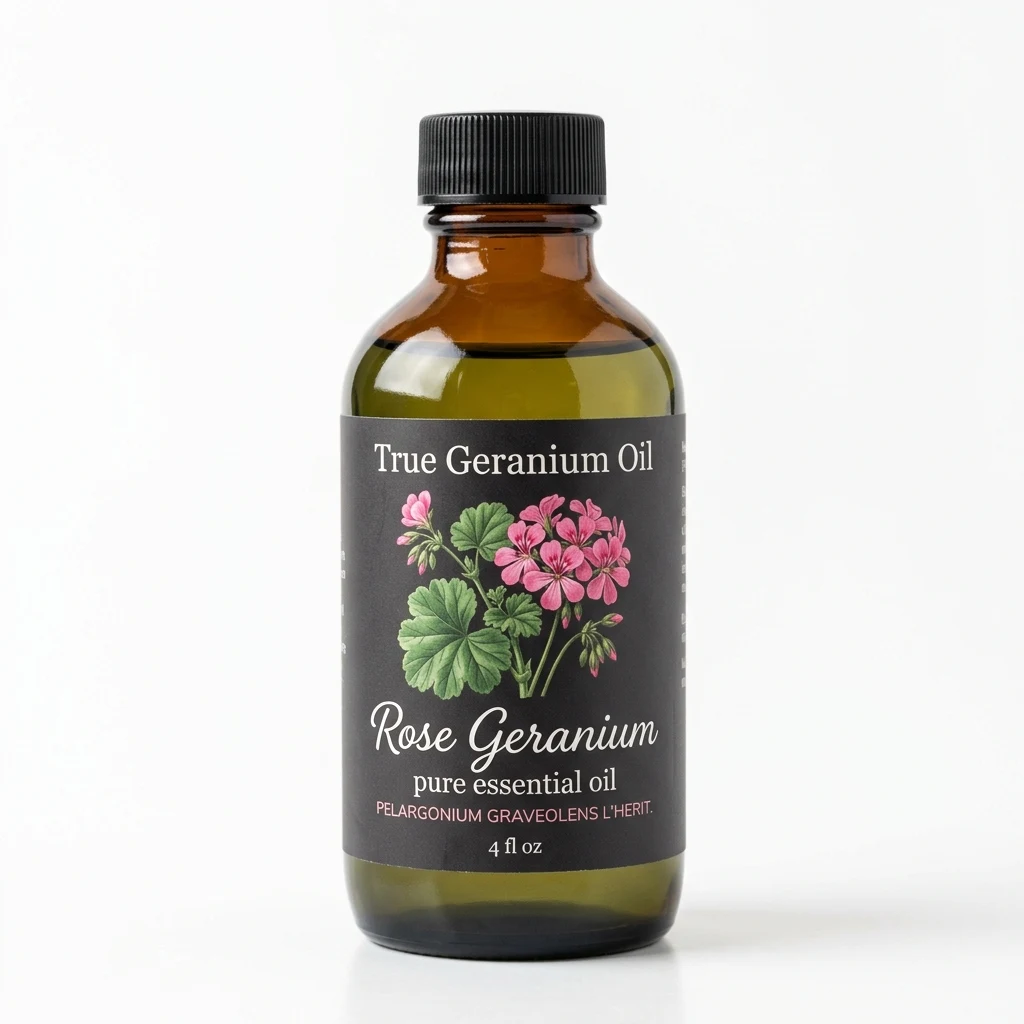
Rose Geranium Essential Oil
Our own Rose Geranium Essential Oil, in sizes from 0.5 oz to bulk.
From $24.99
Shop Now →What IFRA is
The International Fragrance Association publishes Standards that its members agree to follow under a Code of Practice, and it notes that meeting them may not be enough on its own to satisfy national law (IFRA Code of Practice). If you are a small maker you are not bound by the Code, but retailers and marketplaces often ask for IFRA-conformant formulas, so it is worth knowing how to work with them. The figures here come from the 51st Amendment (2023); check for a newer one before you rely on them.
The method in three steps
- Choose the category that matches your finished product. IFRA's guidance places underarm products in category 2, face moisturizers in 5B, body lotion and body oil in 5A, rinse-off body products such as soap in 9, and products not meant for skin contact, such as candles, in 12 (IFRA guidance, 2023).
- Look up how much of each restricted molecule the oil contains. IFRA publishes an annex of typical shares for natural materials, and says restricted substances in natural oils must be counted (IFRA annex).
- Divide the category limit by that share. The answer is the most oil the product can carry on that molecule, and the lowest answer across all molecules is your ceiling.
Geraniol sets the pace
For geranium, geraniol is usually the molecule that decides. The annex gives geranium oil a typical geraniol share of 17.7%, and EFSA's specification allows 10% to 18% (EFSA, 2023). The geraniol limits come from IFRA Standard 037. The right-hand columns are our arithmetic:
| Product type | Geraniol limit | Most oil at 17.7% geraniol | Most oil at 10% geraniol |
|---|---|---|---|
| Underarm (category 2) | 0.25% | 1.4% | 2.5% |
| Face moisturizer (5B) | 0.78% | 4.4% | 7.8% |
| Body lotion or oil (5A) | 1.2% | 6.8% | 12% |
| Soap and rinse-off (9) | 2.8% | 15.8% | 28% |
The reassuring part is how much room there is. At 2%, the top of our suggested range, geranium oil contributes about 0.35% geraniol, which fits every row except underarm products. The table also shows why the answer depends on your actual oil: a bottle at the lower end of the geraniol range gives you nearly double the headroom. If geraniol arrives from other ingredients too, such as rose or palmarosa oil, it all counts toward the same limit; our palmarosa comparison works through a two-oil example.
A tiny worked example
Say you are making a body oil and the product sits in category 5A. The geraniol limit is 1.2%, and geraniol is 17.7% of the oil in IFRA's typical figure. Divide 1.2 by 0.177 and you get about 6.8%, the same number that appears in the table. Then check the citronellol limit, and the citral one, and take the smallest answer. That last step, picking the lowest ceiling, is the habit that keeps the method honest.
Write the calculation on a card and keep it with the formula. When you change a size, an ingredient or a supplier, you can rerun it in minutes, and you will have a record of how you got your number.
Citronellol, citral and linalool
Citronellol has its own limit, 3.2% for categories 5A to 5D and 0.67% for underarm products (IFRA Standard 022). At the annex's 21.1% share that allows about 15% oil in a body lotion and 3.2% underarm, so it rarely overtakes geraniol, though a citronellol-rich oil can narrow the gap. Citral, which the annex puts at 0.5% in geranium oil, caps underarm products at 0.032% (IFRA Standard 021), which works out to about 6.4% oil. (Both of those standards were read at Amendment 49, 2020, and not rechecked against the 51st.)
Linalool works differently: it is a quality specification rather than a cap. IFRA's linalool standard asks that linalool-rich materials be kept low in peroxides, which build up as the oil meets air (IFRA Standard 187). The easy habit that supports this is the one the shop already recommends: tightly capped, cool and dark. Candles, incidentally, fall under category 12, where the geraniol standard has no restriction; how much fragrance the wax can hold is a question for the wax maker.
Putting it to use
Treat the table as a planning aid. The shop suggests 0.5% to 2% in a carrier, with the low end for the face, and the arithmetic fits that well; for underarm products the numbers favor the low end, and for baby products it is best to ask a professional. A patch test comes first for anything new, and anyone pregnant or nursing should check with their physician. IFRA arithmetic is one part of making a product; a cosmetic safety assessor can turn your batch data and finished formula into a complete assessment.
The method works best with the report for the batch you actually buy. The Certificate of Analysis we publish covers one batch and gives its relative density and refractive index; for GC-MS, an allergen declaration or an IFRA statement, ask in writing before ordering. Our guide to reading a GC-MS report shows what to check when it arrives, and the articles on labeling, soap rates and the safety guide pick up where this one stops. Sample bottles are available through our wholesale page.
Do the sum once by hand and it stops feeling mysterious. After that it is just another line in your notes, as ordinary as weighing the oil.
Rose Geranium Essential Oil
Rose Geranium Essential Oil from our own shop, in sizes from 0.5 oz to bulk.
From $24.99
Shop Now →Sources & Further Reading
- IFRA. Code of Practice. ifrafragrance.org
- IFRA, 2023. Standard 037 (Geraniol); 51st Amendment guidance and annex. IFRA_STD_037.pdf
- IFRA. Standards 022 (Citronellol), 021 (Citral) and 187 (Linalool). IFRA_STD_022.pdf
- EFSA FEEDAP Panel, 2023. Geranium rose oil. PMC10373134