How to Read a Geranium Oil GC-MS Report
A GC-MS report looks like something only a chemist could love: columns of compound names, retention numbers and percentages. Strip it back, though, and it is a fingerprint of the oil, a list of what is in the bottle and roughly how much. Once you know four things about how to read it, a geranium oil report becomes a genuinely useful buying tool.
Rose Geranium Essential Oil
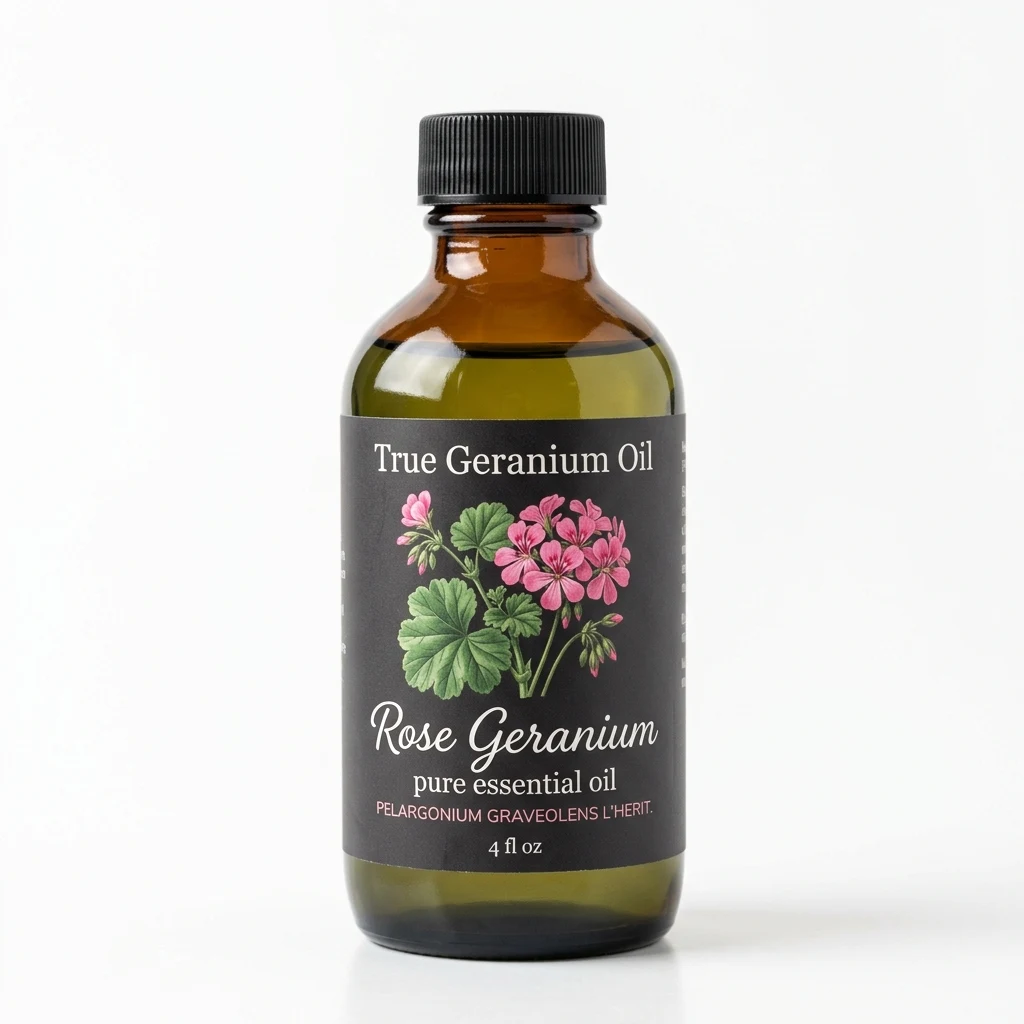
Our own Rose Geranium Essential Oil, in sizes from 0.5 oz to bulk.
From $24.99
Shop Now →First, check it is about your bottle
Before any chemistry, look for a batch or lot number, a date and the laboratory's name. A report with none of those is a portrait of some geranium oil rather than yours. If you are buying for a product you will sell, it is entirely reasonable to ask a supplier to tie the report to the lot you are receiving.
Do not be discouraged if the first report you open looks like a wall of numbers. Start with the top of the page and the bottom: who made it, which batch it covers and what the conclusion says. Then read down the biggest peaks. Everything in between can wait for a second reading, and it helps to save the file with the date you received it.
Then, remember what the numbers are
The percentages on most geranium oil reports are shares of the signal the instrument recorded, usually "% GC area", not shares of the bottle by weight. That is the convention EFSA uses in its geranium rose oil specification, and it is perfectly good for describing a profile. Its quirk is that GC-MS signals are not directly comparable between families of compounds, so reviewers describe this kind of quantitation as useful for comparison but not absolute (Sadgrove et al., 2022).
One consequence is worth knowing about. Researchers testing lavender, lemon and tea tree oils pointed out that mixing an essential oil with a vegetable oil changes neither the list of compounds nor their normalised percentages, so only a calibrated, absolute analysis would reveal it (Capetti et al., 2021). Those were other oils, but the logic carries over: it is fair to ask whether a report's figures are normalised area or calibrated mass.
How do they know which peak is which?
The instrument matches each compound's spectrum against a library, and a library match is a strong hint rather than a final answer. The same Sadgrove review stresses that matches should be confirmed with retention indices, a standardised way of describing when a compound emerges from the column, compared against published values. A good report shows those indices. A table of names and percentages with no indices has skipped the step that makes the names trustworthy.
What a geranium oil profile looks like
Geranium oil is built around two rosy alcohols, citronellol and geraniol, supported by a cast of smaller players including citronellyl formate, linalool, isomenthone and rose oxide. For the North African oil EFSA assessed, the specification allows citronellol from 25 to 36 percent and geraniol from 10 to 18, and five tested batches landed at about 32 and 15 percent (EFSA, 2023).
The useful thing to take from this is that there is no single "correct" geranium profile. Trade figures republished by the Tisserand Institute put Chinese oils higher in citronellol (32 to 43 percent) and lower in geraniol (5 to 12), and they list different marker compounds by type: 10-epi-gamma-eudesmol in Egyptian oil, guaia-6,9-diene in Chinese oil (Tisserand Institute, 2015). So rather than hunting for one ideal number, look for a coherent profile, where the main compounds and the type's markers show up together and the minor players are all present. A report that lists only the top three compounds has told you less than one that lists the supporting cast. Our comparison of Egyptian and Bourbon oils shows how those differences read in practice, and if authenticity is your main question, the adulteration article explains what else a lab can add, such as chiral analysis.
A five-line checklist
- Is there a batch or lot number, a date and a laboratory name?
- Does it say whether the percentages are area or calibrated mass?
- Are retention indices shown?
- Are the main compounds listed with the supporting cast, not just the top three?
- Does the profile look coherent for the type of oil the seller says it is?
Print it, keep it next to the report, and tick the boxes with a pencil. Any box you cannot tick is simply a question for the seller.
Where our Certificate of Analysis fits
The Certificate of Analysis we publish covers one batch and reports two physical measurements at 20 C: a relative density of 0.881 and a refractive index of 1.470, each inside the stated standard range. Think of those as quick consistency checks, like checking a wine's colour and weight, rather than a chemical breakdown. If your product needs a GC-MS report, an allergen declaration or confirmation of species or origin, ask us in writing before you order. Our wholesale page also offers sample bottles to evaluate in your own product, and you are always free to have a sample analysed by a laboratory of your choice.
If you are comparing reports from two suppliers, line them up side by side and read the same rows in each. Differences in layout can hide similarities, and a simple highlighter pen on the main compounds makes the comparison much quicker.
Once you can read one, a GC-MS report is simply a way of asking the bottle to introduce itself, and it pairs nicely with the background in the plant guide and the chemistry of citronellol and geraniol.
Rose Geranium Essential Oil
Rose Geranium Essential Oil from our own shop, in sizes from 0.5 oz to bulk.
From $24.99
Shop Now →Sources & Further Reading
- Sadgrove, Padilla-Gonzalez and Phumthum, 2022. Fundamental Chemistry of Essential Oils and Volatile Organic Compounds, Methods of Analysis and Authentication, Plants 11(6):789. pmc.ncbi.nlm.nih.gov/PMC8955314
- Capetti et al., 2021. Adulteration of Essential Oils: A Multitask Issue for Quality Control, Molecules 26(18):5610. pmc.ncbi.nlm.nih.gov/PMC8471154
- EFSA FEEDAP Panel, 2023. Geranium rose oil, EFSA Journal 21(7):e08161. pmc.ncbi.nlm.nih.gov/PMC10373134
- Tisserand Institute (republishing ITC Market Insider, 2015). Geranium oil history and cultivation. tisserandinstitute.org