Geranium Soap Problems: Is It the Oil or the Method?
You unmold the bars, and something is off: the batter thickened in a flash, the color went tan, or there are cracks across the top. The new scent is the obvious suspect, but soap has plenty of ways to surprise even a seasoned maker. Here is how to read each symptom, check the usual causes first, and, if you still wonder about the geranium, give it a fair trial of its own.
Rose Geranium Essential Oil
Our own Rose Geranium Essential Oil, in sizes from 0.5 oz to bulk.
From $24.99
Shop Now →Thickening fast, ricing and oil on top
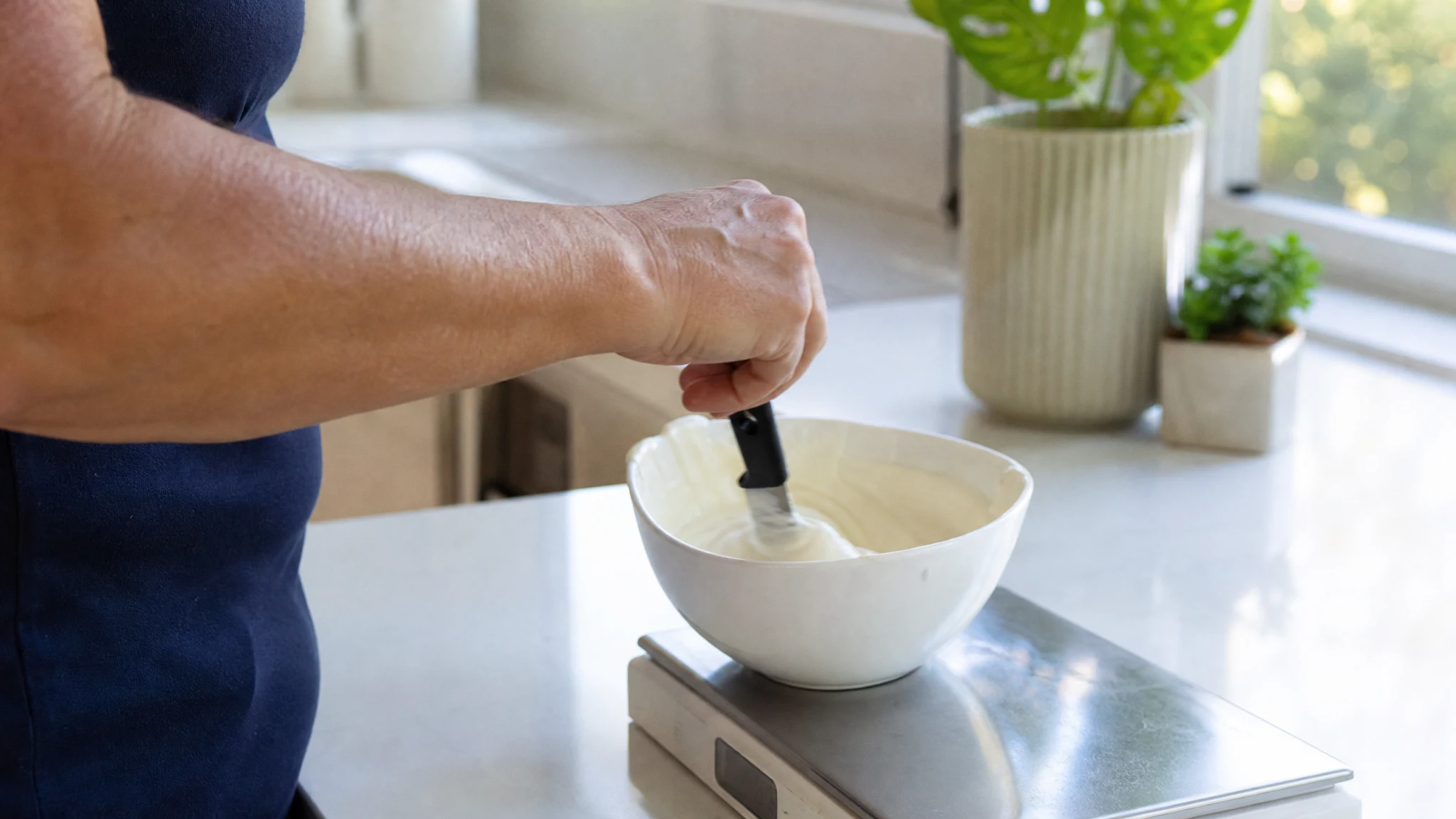
Soapmakers call it acceleration when a scent brings the batter to trace extremely quickly, and it is mostly a story about fragrance chemistry and mixing. Soap Queen notes that stick blending can make even well-behaved fragrances accelerate or seize, and it generally suggests whisking scent in after trace; rice-like lumps happen when an ingredient binds with the harder oils, and oil pooling on top means the scent did not mix in (Soap Queen, Soap Behaving Badly). A popular essential oil chart takes a different approach, adding oils at emulsion or very light trace, and it flags only cinnamon leaf and clove leaf as speeding trace; geranium carries no such note (The Nerdy Farm Wife). So there is more than one school of thought on timing, and your own method is the first place to look.
Water matters too. A batter with less water starts at a higher lye concentration and has less time before it thickens. With 144 g of lye, 300 g of water gives a 32% solution and 250 g gives 37%. That is simple arithmetic, not a measured finding, but it is a good reason to check recipe and temperatures before blaming a scent.
A seizing batch is also a moment for gloves and goggles. NIOSH lists sodium hydroxide as causing burns to skin and eyes and advises flushing immediately (CDC/NIOSH Pocket Guide), so wear both while you scrape a pot out.
Color changes
Brown or darker bars most often trace back to vanillin in a vanilla-containing fragrance, which darkens as a natural process, and Soap Queen adds that other aroma chemicals may discolor too (Soap Queen, vanillin). The Certificate of Analysis we publish describes one batch of geranium oil as a yellow liquid, and at about 14 g in a batter of roughly 1,470 g (under 1%) it adds very little color. If your bars darken, check for vanilla, clays or colorants first.
Cracks, volcanoes and glycerin rivers
These come from heat. Gel phase can warm soap to as much as 180 F, and Soap Queen says a heating pad left on too long can cause volcanoes, heat tunnels or glycerin rivers. To keep soap cool, it suggests starting lye and oils around 90 to 100 F and using the refrigerator or freezer for 24 hours, or a cool spot with a fan; to encourage gel, 120 to 130 F (Soap Queen, All About Gel Phase). If you used a heating pad, a warm room or thick insulation, start there.
Orange spots weeks later
Those spots are rancidity at work, an oxidation of the oils themselves. A chemistry professor and students aged sealed soap vials at 60 C and tracked color daily. Olive oil soap reached a noticeable orange in about 100 hours with oxygen present against about 250 hours in nitrogen, coconut oil soap was much less affected, and dissolved calcium and iron sped things up. Tetrasodium EDTA, BHT and rosemary oleoresin extract each delayed it at 0.1% of oil weight (Wholesale Supplies Plus, 2025). It was a heated-vial test with two soaps, so treat it as a clue rather than a shelf-life guarantee. The practical lesson is to start with fresh oils, store them well and mind your superfat.
A fair trial for the geranium
If everything above checks out and you still want to know how geranium behaves in your recipe, a split test answers it in an afternoon. Make three mini-batches of 100 g oils with the same recipe, temperatures and method. With 5% superfat and 70% olive, 30% coconut, each needs about 14.4 g lye and roughly 30 g water, the same basis as our soap blends article.
- Batch 1: no scent, your baseline for speed, temperature and color.
- Batch 2: 1.4 g geranium oil whisked in after trace, about 1% of the batter.
- Batch 3: the same 1.4 g stick blended in at light trace.
If Batch 1 misbehaves, the recipe or temperature is the cause. If only Batch 3 does, it is the blending method. If Batches 2 and 3 both do, you have your answer about the oil, and you can lower the rate or change partners. Use a scale, since 1.4 g is roughly 30 drops and droppers vary. Test with the oil you plan to use in production.
Keep a batch log
The easiest troubleshooting tool is a notebook. Write the date, the weights, the temperatures when you mixed, what you saw at trace and how you cured the bars. When something goes wrong, the answer is nearly always in the page you wrote down the day before. A log also makes your good batches repeatable, which matters just as much.
Where to go next
Scent that fades after cure is its own topic, covered in making the scent last. The rate itself is in the usage rate article, and the whole method is in the soap-making guide and the recipe article. If you plan to scale up, ask us in writing about any safety data sheet or allergen declaration you need before ordering. The only document we publish is the certificate for one batch, so it is best to know early.
Most soap problems turn out to be about heat, water or timing, and each is fixable on the next batch. Keep notes on weights and temperatures and the mystery usually solves itself.
Rose Geranium Essential Oil
Rose Geranium Essential Oil from our own shop, in sizes from 0.5 oz to bulk.
From $24.99
Shop Now →Sources & Further Reading
- Soap Queen, 2014. Soap Behaving Badly. soapqueen.com/?p=34870
- Soap Queen, 2024. Vanillin discoloration in cold process soap. soapqueen.com/?p=72429
- Soap Queen, 2024. All About Gel Phase. soapqueen.com gel phase
- Wholesale Supplies Plus, 2025. Orange You Glad: the chemistry of DOS. wholesalesuppliesplus.com
- Berry J. 30 Essential Oils for Soapmaking, The Nerdy Farm Wife. thenerdyfarmwife.com
- CDC/NIOSH, 2019. Pocket Guide to Chemical Hazards: sodium hydroxide. cdc.gov/niosh/npg/npgd0565