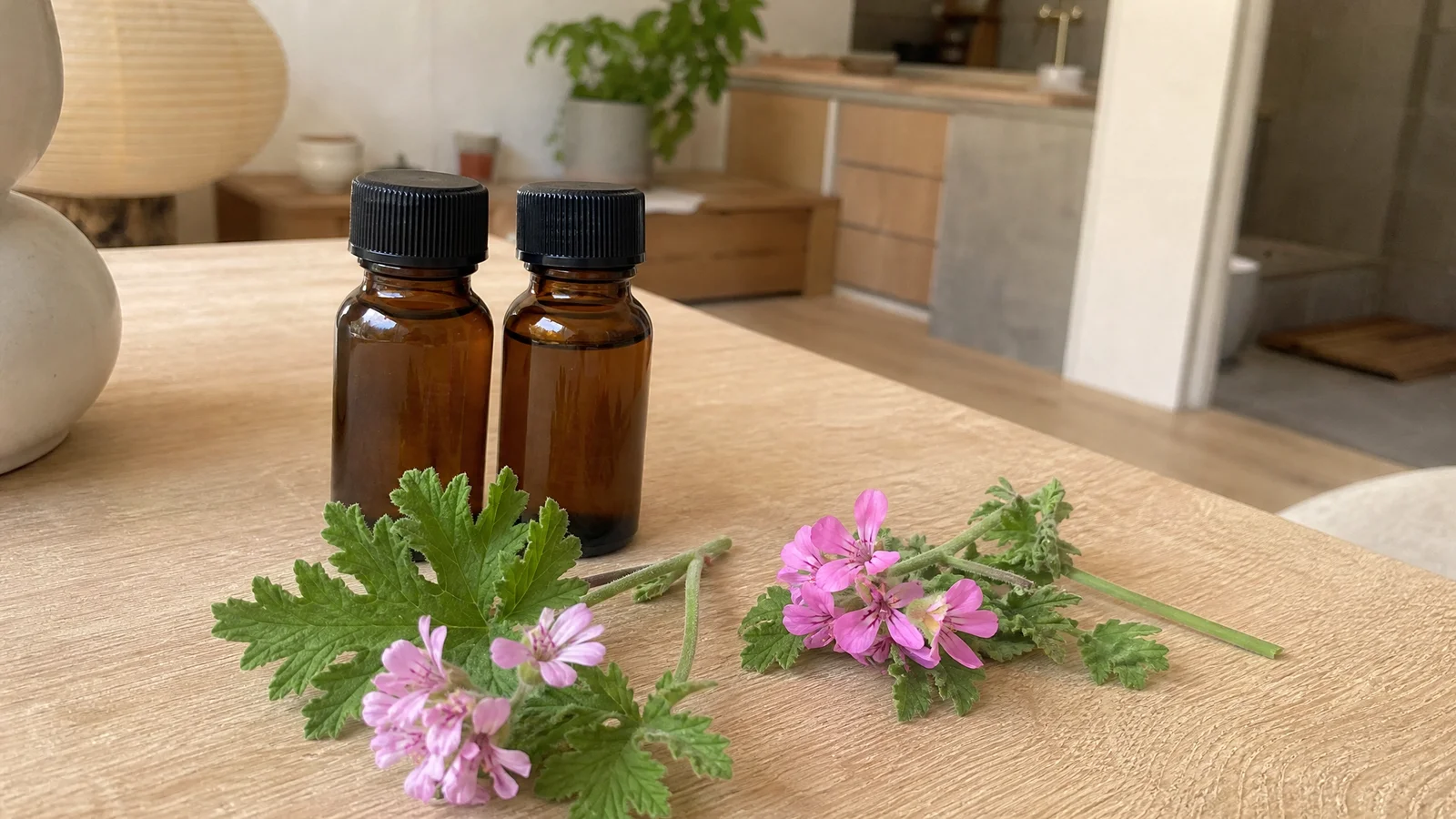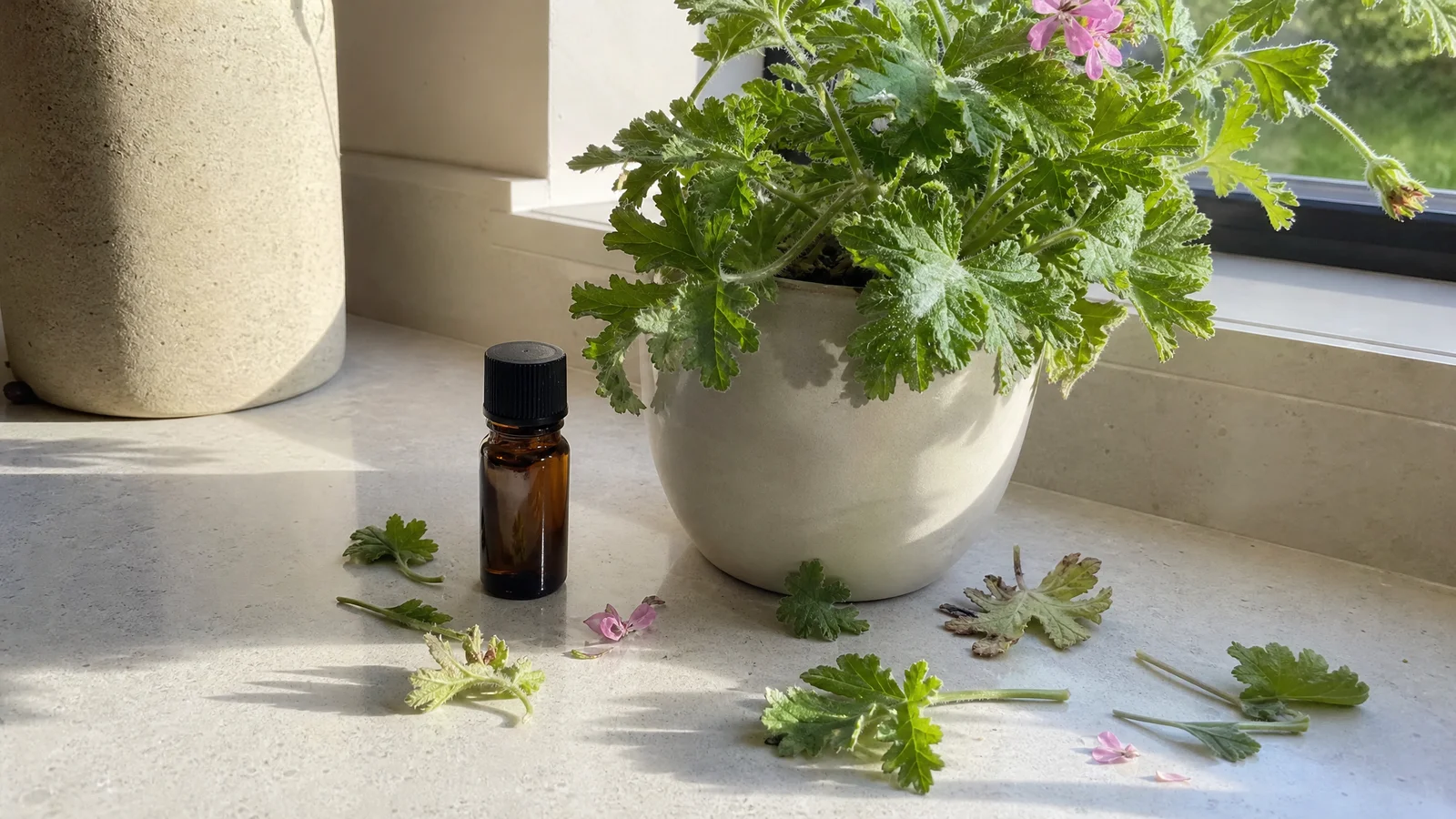
How to Diffuse Geranium Oil: Drops, Timing and Safety
Geranium is one of those oils that makes a room smell like someone has been cutting roses and crushing green leaves at the same time. In a diffuser it is bright, rosy and a little minty, and it does not take much to fill a space. That last part is the whole secret of diffusing it well: a few drops, a short run, and a window you are happy to open.
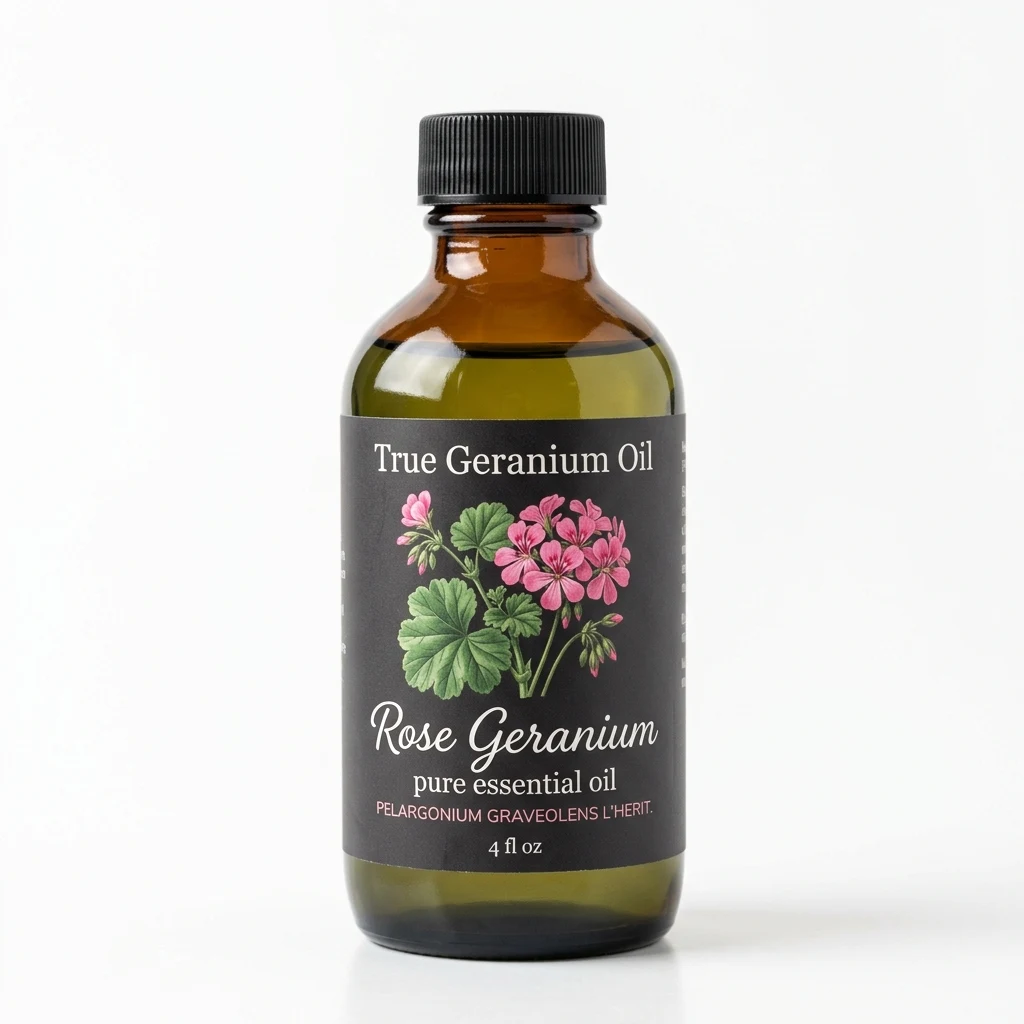
Rose Geranium Essential Oil
Our own Rose Geranium Essential Oil, in sizes from 0.5 oz to bulk.
From $24.99
Shop Now →What to expect from the scent
The shop describes our Geranium Essential Oil as rosy, green and lively, "crushed leaves wrapped around a rose heart", with minty and citrusy glints, and our Rose Geranium Essential Oil as the rosier of the pair, softly sweet and floral with a minty-herbal edge. Both are middle notes, so in a diffuser they sit in the body of a blend: not the sparkle that hits first, not the base that lingers last. If you would like a longer look at the aroma itself, what geranium oil smells like goes through it note by note.
The first few minutes in a room are usually the greenest, with a leafy, slightly minty lift, and the rose shows itself a little later. If you step out of the room and come back in, your nose gets a fresh start and you will notice the scent again the way a guest would.
Choosing partners
Our two geranium pages suggest bergamot, lavender, sandalwood, clary sage, ylang ylang, patchouli and grapefruit as companions. Geranium is the sort of oil that makes other scents feel rounder, so a good way to start is with geranium as the heart and one partner to change the mood: a citrus for a fresher room, lavender for something softer, patchouli or sandalwood for a deeper, earthier one. We sell only our two geranium oils, so you would find those partners at a craft or supply shop. For what each one brings to the mix, see the blend partners article.
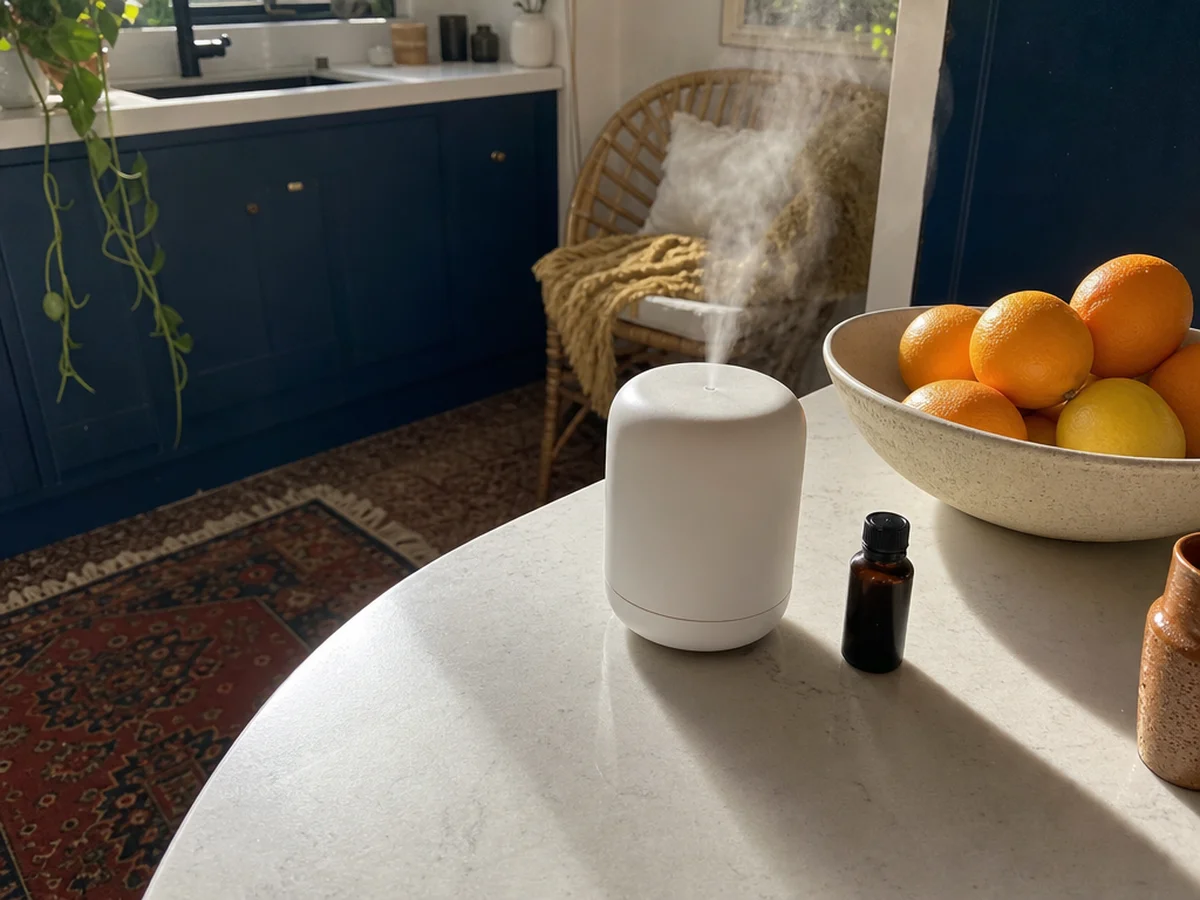
Think in proportions rather than drops. Whatever total your diffuser's manual allows, you might give geranium half or two thirds of it and share the rest between one or two partners. If the manual says six drops, that is four of geranium and two of something else. It is simple arithmetic, and it keeps the blend easy to adjust next time.
Why fewer drops is a better plan
A diffuser is a quiet little aerosol machine, and the scent you notice is only part of what leaves it. In a chamber study of ultrasonic diffusers, researchers measured both volatile compounds and fine particles coming off lemon, lavender and eucalyptus oils, and the amounts differed by oil. One surprise was that plain grapeseed oil, which has no scent at all, released the most particles. Filling a diffuser with tap water instead of deionized water raised particle emissions about fivefold for eucalyptus. The authors concluded that ordinary home use can add noticeably to the particles in indoor air, depending on the oil and the water (Schwartz-Narbonne et al., Indoor Air, 2021). Geranium was not among the oils tested, so we can't put a number on it. The practical reading is simply to use the water your manual asks for and keep the drops modest.
Room size matters just as much. In a field study where fifty volunteers ran diffusers in their own cars and studio apartments, the levels of the oils' main compounds rose in both places, most strongly in vehicles, and the authors suggest taking care in small, enclosed spaces (Kim et al., Science of the Total Environment, 2023). A drops-per-water figure in a manual is written for a particular room size, so treat it as a ceiling rather than a target. A bedroom or living room with some fresh air beats a closed car every time.
How many drops reach the air from a given number in the tank is not something we can calculate for geranium. For a sense of scale, the Certificate of Analysis we publish covers one batch and gives a relative density of 0.881, so at about 20 drops to the millilitre one drop of that batch weighs roughly 44 milligrams. Droppers vary, so that is a guide, not a promise.
A comfortable routine
- Run it for 20 to 30 minutes at a time with a window slightly open, then let the room air out.
- Keep it in a living area and away from where babies, or anyone sensitive to fragrance, spend most of their time.
- Use the water your manual specifies, and rinse and wipe the reservoir between oils so that old residue does not muddy a new blend.
- Jot down the drops, the room and the minutes. A tiny note makes it easy to repeat a blend you loved and trim one that felt too strong.
Pets and people who should skip it
Animals deserve a special mention. The Merck Veterinary Manual explains that active diffusers, the ultrasonic and nebulizing kinds, release microdroplets that can settle on a pet's fur or feathers and be swallowed during grooming, which is why cats and birds are of particular concern. Its guidance is to keep pets out of the room while a diffuser runs, ventilate afterwards and run it only for short periods. It does not single out geranium, but the advice is general (Merck Veterinary Manual, March 2025). If a cat or bird shares your home, a veterinarian is the right person to ask before you buy a diffuser. The same goes for a physician if there is a young child or someone with asthma in the house, or if you are pregnant. Our shop copy keeps the oil away from children and pets and says it is not for internal use, and we sell an external cosmetic oil, so those conversations belong with the professionals.
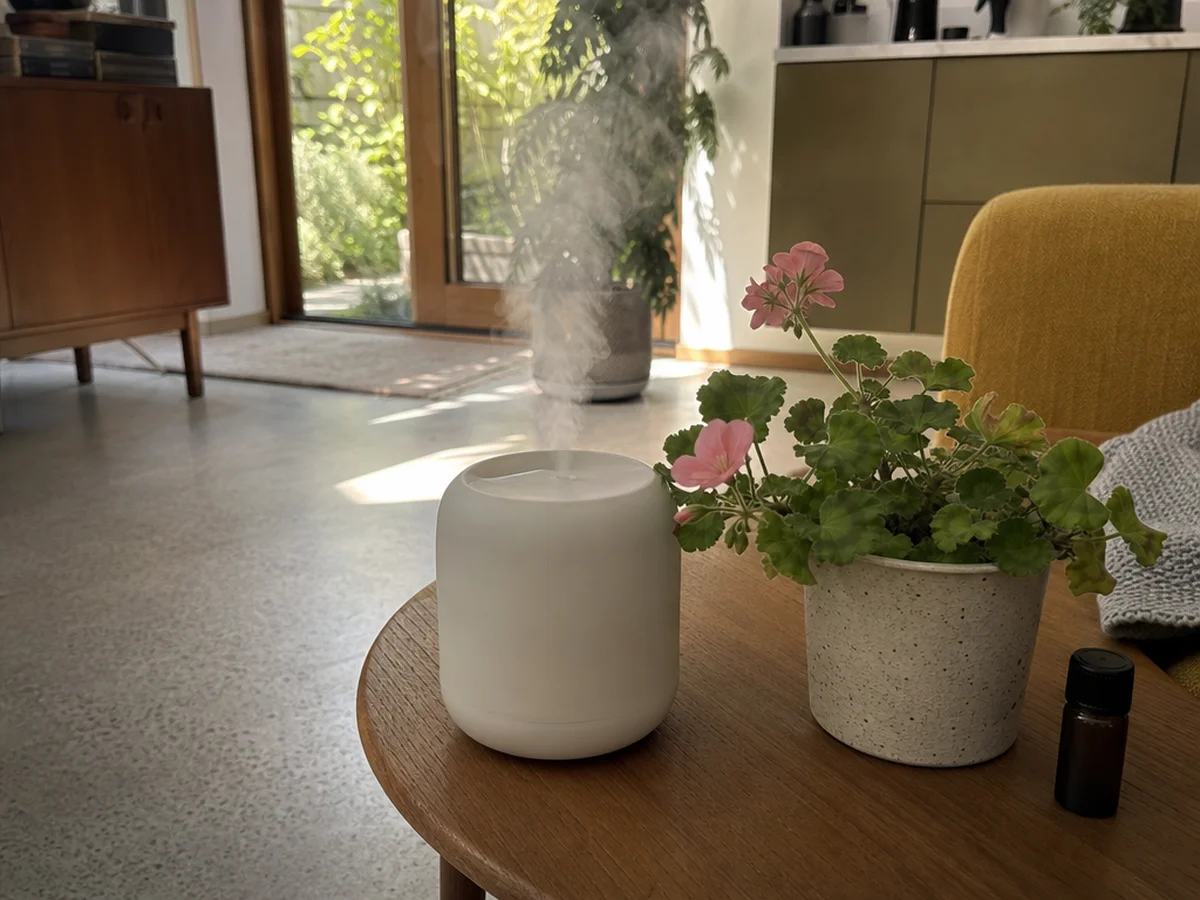
If you love the scent but would rather skip the aerosol, a reed diffuser or a room and linen spray gives you the same rosy character with no mist at all, and the home fragrance guide compares the formats. Whichever you choose, start small. Geranium tends to be more generous than you expect.
Rose Geranium Essential Oil
Rose Geranium Essential Oil from our own shop, in sizes from 0.5 oz to bulk.
From $24.99
Shop Now →Sources & Further Reading
- Schwartz-Narbonne H, Du B, Siegel JA, 2021. Volatile organic compound and particulate matter emissions from an ultrasonic essential oil diffuser. Indoor Air. pubmed.ncbi.nlm.nih.gov/33905580
- Kim PG, Lee A, Shin J, et al., 2023. Determination of terpene levels after the use of essential oil diffusers in vehicles and studio apartments using passive sampling. Science of the Total Environment. pubmed.ncbi.nlm.nih.gov/36965723
- Merck Veterinary Manual, March 2025. Toxicoses from essential oils in animals. merckvetmanual.com