DIY Rose Geranium Roll-On: How Many Drops to Use
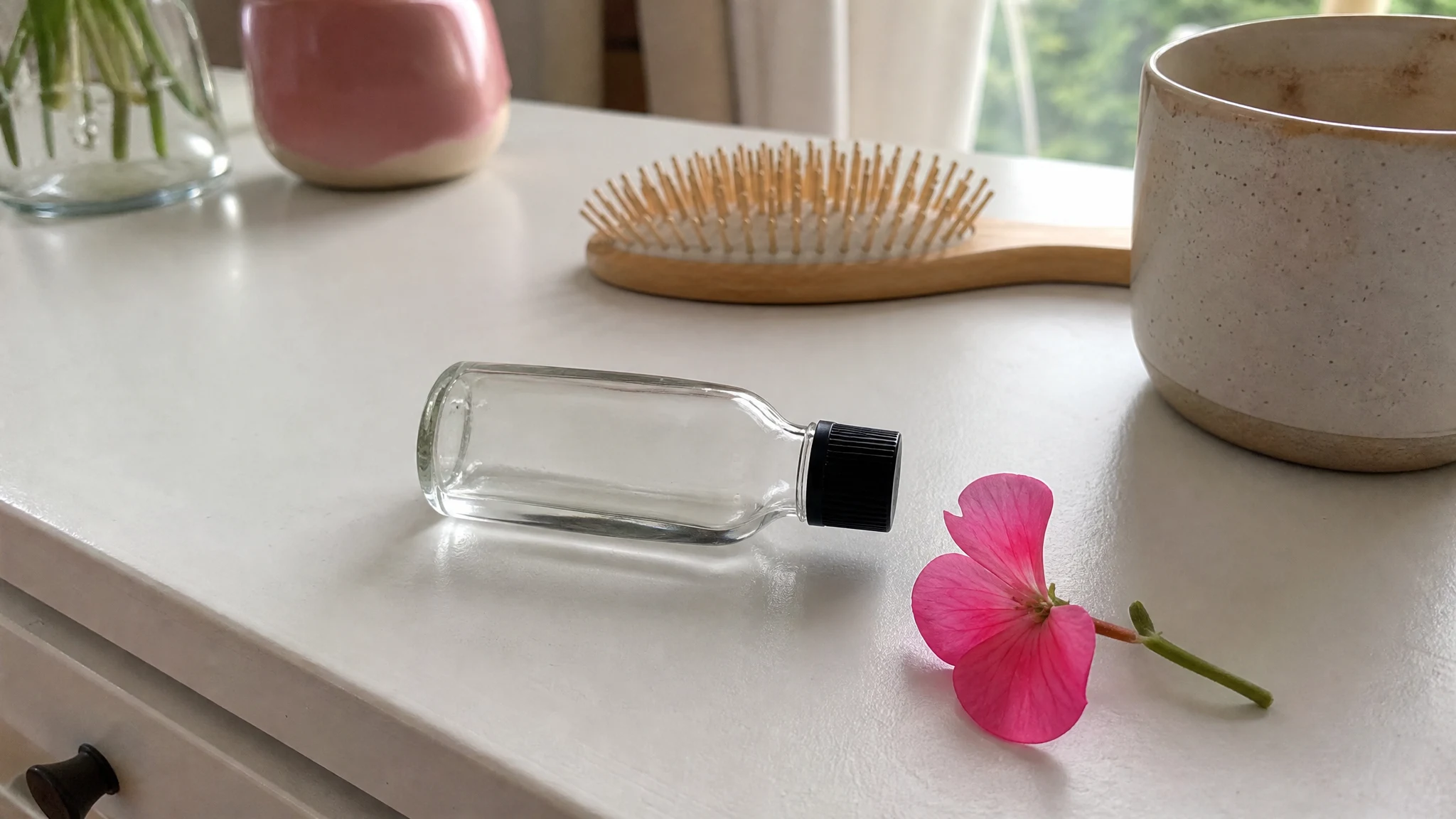
A roll-on perfume is one of the simplest ways to carry a scent with you, and rose geranium suits it well: rosy, green and soft, a scent that sits close to the skin instead of announcing itself across the room. In a 10 ml roller bottle, every drop of geranium oil is about 0.5 percent, so the whole recipe is a matter of counting to four at most.
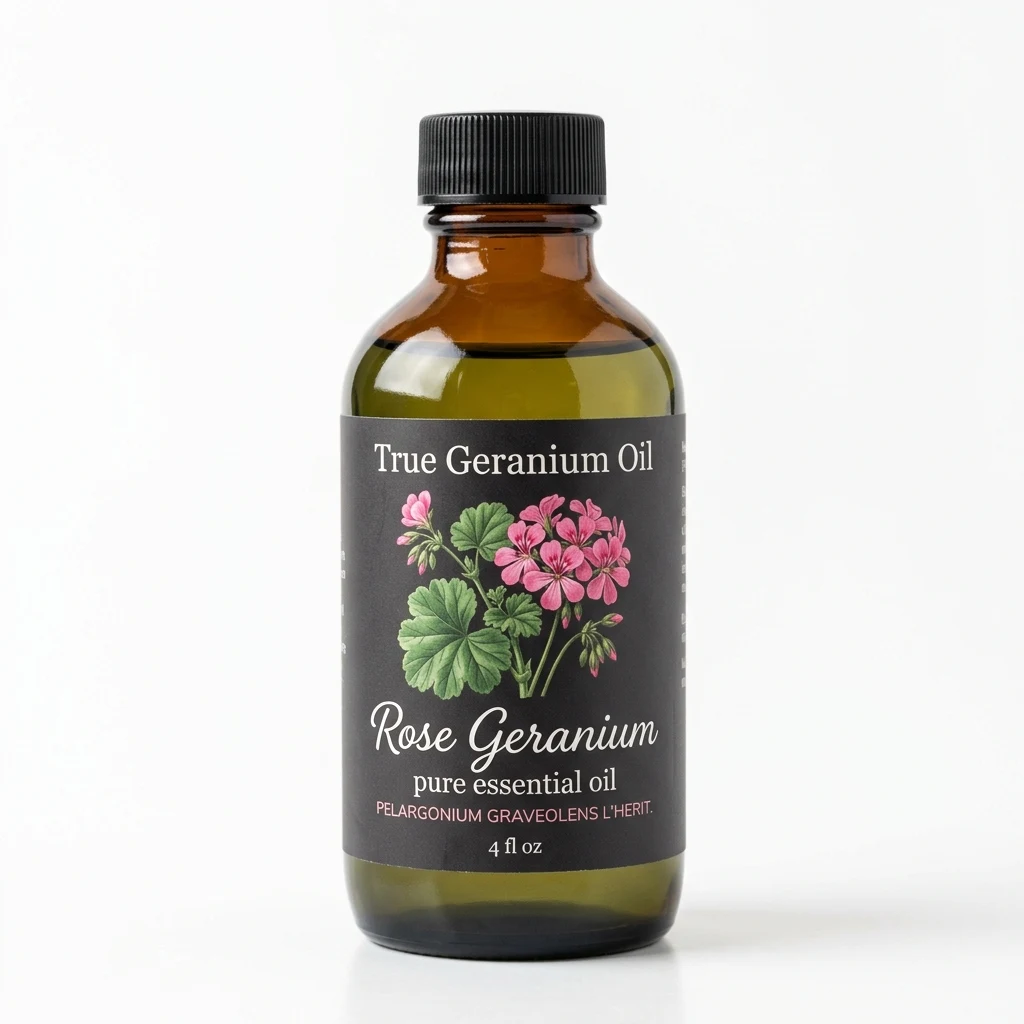
Rose Geranium Essential Oil
Our own Rose Geranium Essential Oil, in sizes from 0.5 oz to bulk.
From $24.99
Shop Now →The drop chart
The numbers assume a 10 ml bottle filled with carrier oil and about 20 drops to the millilitre. Droppers vary, so treat the drop counts as a good estimate.
| Strength | Geranium drops in 10 ml | Best for |
|---|---|---|
| 0.5% | 1 | Near the neck or face, or if you are cautious with fragrance |
| 1% | 2 | A first roll-on for wrists and inner elbows |
| 1.5% | 3 | A little more presence |
| 2% | 4 | The top of our range |
Add the drops, cap the bottle and roll it between your palms to mix. Test a small area before wearing it on a pulse point.
Why we stop at four drops
You may see higher numbers elsewhere. The Tisserand Institute lists 3% to 10% as a general range for rollerball-style use on a small area of skin, and 0.2% to 1% for sensitive skin (Tisserand Institute). Those are broad figures for essential oils in general. Our line for geranium is 0.5% to 2% in a carrier, and we like that range for a roll-on because the oil is lively and carries well even at modest strength.
A 2% roll-on is a quiet skin scent that you notice when you lift your wrist, rather than a perfume that fills a room, and that is part of its charm. If you want more presence, add more places to apply rather than more oil in the bottle, or explore geranium in natural perfumery.
Counting or weighing
No two drops are alike, so if you like precision, weigh the oil. At 2% in 10 ml, you are after about 0.18 g of geranium oil; at 1%, about 0.09 g. A scale reading to 0.01 g handles it nicely. If your dropper produces large drops, use one fewer than the chart suggests.
Choosing a carrier
We sell geranium oils and not carriers, so pick your carrier up at a craft or cosmetic supply shop or a grocery store. The Rose Geranium page names jojoba and sweet almond oil as examples. Jojoba is a nice fit for roll-ons that live in a bag: in a heat-ageing study of jojoba, olive oil and squalene, jojoba came through with the lowest oxidation readings (Tsuchimoto et al., 2022), though that is a lab test and not a shelf-life promise. If anyone using the roll-on has a tree nut allergy, jojoba is also the easier choice than almond, and an allergist can advise on the rest. Our carrier oil guide has more.
A blending partner worth trying
The shop lists bergamot among the oils that blend well with rose geranium, and the pairing is a pretty one: bright citrus lifting a rosy-green heart. If you try it, choose bergamot FCF, the furocoumarin-free version, because the Tisserand Institute treats ordinary bergamot as phototoxic on sun-exposed skin and the FCF version as non-phototoxic (Tisserand Institute). We do not sell bergamot, so look for it at a supplier you trust. A balanced two-oil roll-on is 2 drops of geranium and 2 drops of bergamot FCF in 10 ml. That is 1% each, 2% in total, so remember that every oil in the bottle counts toward the same limit.
Where to wear it
Once your patch test has passed, roll a thin line on the insides of the wrists and let it sit for a moment before you touch anything. Because a roll-on is oil, it takes a minute to settle and does not fade away the way an alcohol perfume does. Keep it off the face and eyes, and wash your hands after applying. If you want to smell it more, roll on a little more at the next spot rather than adding more oil to the bottle.
Making it a small ritual
A roll-on is lovely to make in a small batch because you can name it, label it and carry it. Choose a bottle that you can clean easily, pick a quiet moment and measure carefully. Write the date, the strength and the oil on a small label. If you make a few bottles at different strengths, number them, so that when you find the one you like best you know exactly what to repeat.
Patch test, storage and a few cautions
Try a small dab on the inner forearm first, as the shop advises, and see our patch test guide for what a home test can show. A dermatologist's patch test is a longer procedure, with 48 hours of wear and a follow-up reading four to seven days later (American Academy of Dermatology), and it is the better route if you have eczema or a known fragrance allergy.
Date the bottle. We say its oil typically keeps for 2 to 3 years tightly capped in a cool, dark place, but a diluted roll-on is only as long-lived as its carrier, so make small batches and finish them within the carrier's best-by date. Keep it away from eyes, children and pets. If you are pregnant, nursing or have a medical condition, check with your physician before using it, as our disclaimer asks.
That is the whole recipe: a drop per half percent, a handful of drops at most, and a patch test before the first wear. When you are ready to mix one up, the Rose Geranium Essential Oil is waiting, and the room and linen spray is a good companion for the rest of the house.
One small bottle, a few careful drops and a patch test: that is all a roll-on really needs.
Rose Geranium Essential Oil
Rose Geranium Essential Oil from our own shop, in sizes from 0.5 oz to bulk.
From $24.99
Shop Now →Sources & Further Reading
- Tisserand Institute. Essential oil dilution. tisserandinstitute.org/dilution-essential-oils
- Tisserand Institute. Phototoxicity. tisserandinstitute.org/safety/phototoxicity
- Tsuchimoto, Sakai, Fukui, 2022. Oxidative stability and antioxidant activity of crude jojoba oil. BPB Reports 5(6). jstage.jst.go.jp
- American Academy of Dermatology. Patch testing. aad.org/patch-testing-rash