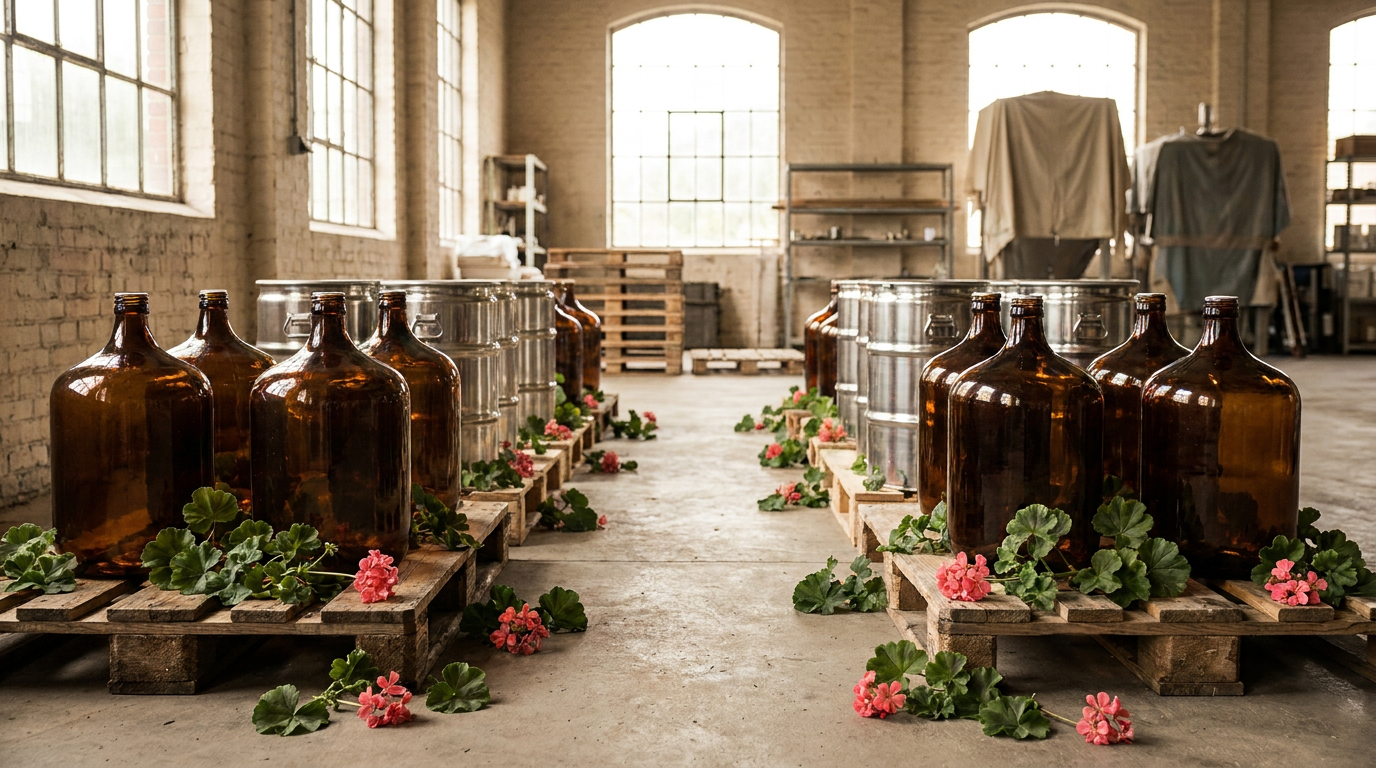
Geranium oil sold by the pound is a different purchase than geranium oil sold by the bottle: origin claims multiply, extraction consistency starts to matter batch to batch, and the paperwork a supplier can produce becomes the real point of comparison. This guide walks through what wholesale buyers are actually buying when they order Pelargonium graveolens oil in bulk, and how to tell a legitimate lot from a relabeled one.
Check current wholesale pricing and size breaks on the bulk order page.
True geranium oil is steam distilled from the leaves and stems of Pelargonium graveolens, the rose-scented geranium grown for its leaf oil rather than its flowers. How the distillation actually runs shapes what ends up in a wholesale drum: yield per harvest is low relative to bulkier herbs, so the oil trades at a price point closer to specialty florals than to common carriers or camphoraceous oils.
The most prized material is still called Bourbon geranium, a name that traces to Reunion Island's geranium trade, even though the bulk of today's supply is now distilled in Egypt and China from stock descended from that same lineage. Buyers who ask suppliers to name a specific origin, rather than accept 'Bourbon type' as a blanket label, get a much clearer read on what they are actually receiving; Egyptian and Bourbon lots compared side by side shows how much the aroma profile can shift with growing region alone.
The rosy, green character wholesale buyers are paying for comes down largely to two constituents, citronellol and geraniol, and the chemistry behind that rosy profile is worth understanding before setting a formulation ratio, since the balance of the two shifts the scent from green-leaning to sweeter and more floral.
| Sold as | What it actually is | How to recognize it |
|---|---|---|
| Bourbon Geranium | the trade name for geranium oil descended from Reunion Island stock, now distilled mainly in Egypt and China rather than on the island itself | ask the supplier to name the actual distillation country and compare the aroma against a reference batch rather than trusting the name alone |
| Rose Geranium | the common name for the exact same Pelargonium graveolens oil, not a separate rose-and-geranium blend | if a listing implies a blend with true rose, ask for the botanical name to be confirmed on the certificate of analysis |
| Geranium Fragrance Oil | a synthetic or partly synthetic reconstruction built to mimic the aroma, not a plant distillate | check for the word 'fragrance' versus 'essential' and request a certificate of analysis, since fragrance oils do not carry one |
| Chinese Geranium | a lower-cost origin now supplying a large share of the wholesale market, grown from the same Bourbon-descended cultivars | origin alone does not determine quality; request a batch-specific aroma sample before committing to drum-scale volume |
None of these labels are inherently disqualifying: Egyptian and Chinese material fill most wholesale demand today, and a well-run distillery in either country can produce oil that performs identically to a Reunion Island lot in a finished formula. The honest comparison against rose otto is a useful frame for buyers evaluating whether geranium oil will do the job a costlier rose material would otherwise cover.
The real trap is not origin, it is documentation: a drum labeled 'Bourbon geranium' with no certificate of analysis behind it is a bigger risk than a plainly labeled Egyptian lot that comes with full batch paperwork.
Wholesale buyers of geranium oil cluster around a few recognizable roles: soap makers scaling a rosy-green bar past small-batch volume, skincare formulators building balancing-style facial and body oils, natural perfumers using geranium as a working substitute for rose, and candle or home-fragrance brands rounding out floral blends. The full range of what this oil is used for gives a sense of how wide that buyer base actually is.
What these buyers share is a need for consistency across a production run, not just a pleasant single bottle. A formulator reordering a facial oil every quarter needs the fourth drum to smell like the first, which is why batch-level documentation matters more here than it does for a one-off hobbyist purchase; the buying guide for this oil covers the quality checks worth running before a purchase order goes out.
Before placing a wholesale order, run a supplier through the following checklist.
Treat the certificate of analysis as the actual product being purchased and the oil in the drum as the delivery mechanism: paperwork that cannot be produced on request is the clearest early warning a wholesale buyer gets.
Geranium oil's size ladder runs from a 0.5 oz sampler bottle up through 400 lb drums, and the right entry point depends on where a buyer sits in production rather than on price per ounce alone.
Choosing a first bottle and the wholesale sizing and pricing breakdown both cover the same ladder from opposite ends: one for a buyer testing a formula, the other for a buyer ready to place a standing order.
Start with a small bottle, typically 1 oz or 2 oz, to confirm the aroma and dilution behavior against your formulation before committing further.
Run the sample through an actual batch of the finished product, whether that is a soap trial, a facial oil blend, or a diffuser mix, rather than judging the oil straight from the bottle.
Move to a pound-tier size, 5 lbs or 25 lbs, once the formulation is set, and request the certificate of analysis for that specific lot before it ships.
For recurring production, arrange a standing order at 100 lbs or 400 lbs so pricing and lead time are settled ahead of each run rather than renegotiated every time.
The sections below cover the wholesale buyer categories this oil actually serves, drawn from how it is used rather than a generic bulk-oil template.
Balancing, rosy-green facial and body oils are one of the largest wholesale categories for this oil, and formulators buying by the pound need consistent aroma from batch to batch.
Read the sourcing guide →Cold-process and melt-and-pour soap makers use geranium as an affordable rosy top note that survives saponification better than many florals.
Read the sourcing guide →Perfumers reach for geranium as a working stand-in for rose otto, and wholesale buyers in this category care more about aroma nuance than price per pound.
Read the sourcing guide →Candle and room-spray brands use geranium to round out floral blends without leaning on costlier rose materials, especially in linen and diffuser lines.
Read the sourcing guide →Scalp and hair care brands use geranium as a floral top note in scalp massage oils and rinse-out formulas, buying by the pound once a ratio is set.
Read the sourcing guide →Blend brands buy geranium in bulk to round out floral diffuser lines, pairing it with citrus and wood notes rather than running it as a standalone scent.
Read the sourcing guide →Linen spray and room spray brands use geranium as an affordable floral base note, buying by the pound for water- or alcohol-based formulas.
Read the sourcing guide →Reach out for lead times, minimums, or a sample of the current batch.
Our own Geranium Essential Oil, in sizes from 0.5 oz to bulk.
From $15.99
Shop Now →