
How to Buy Geranium Oil: The Complete Guide to Types and Quality

Key Takeaways
- Not all geranium oils are the same. Origin, species, distillation method, and certification all affect what ends up in your bottle.
- The two main commercial types are Pelargonium graveolens (Egyptian and Bourbon) and Pelargonium roseum (often sold as rose geranium). Both come from the same genus but offer different scent profiles.
- Quality markers you can evaluate before buying include GC/MS testing availability, Latin binomial labeling, country of origin disclosure, and certifier transparency.
- Organic certification matters most when you plan to use the oil on skin at high frequency.
- Bottle size affects value. Starting with a 10 mL or 15 mL bottle is wise for a first purchase; larger sizes suit formulators and dedicated users.
- Price alone is a poor quality signal. Some premium oils are genuinely worth more; others simply charge more without justification.
What Is Geranium Oil (and What It Is Not)
True geranium oil is steam-distilled from the leaves, stems, and flowers of plants in the Pelargonium genus. The name causes instant confusion because the garden geranium most people know belongs to a different genus entirely. The fragrant, oil-bearing plants used commercially are pelargoniums: South African in origin, now grown across Egypt, Réunion Island, Morocco, China, and beyond.
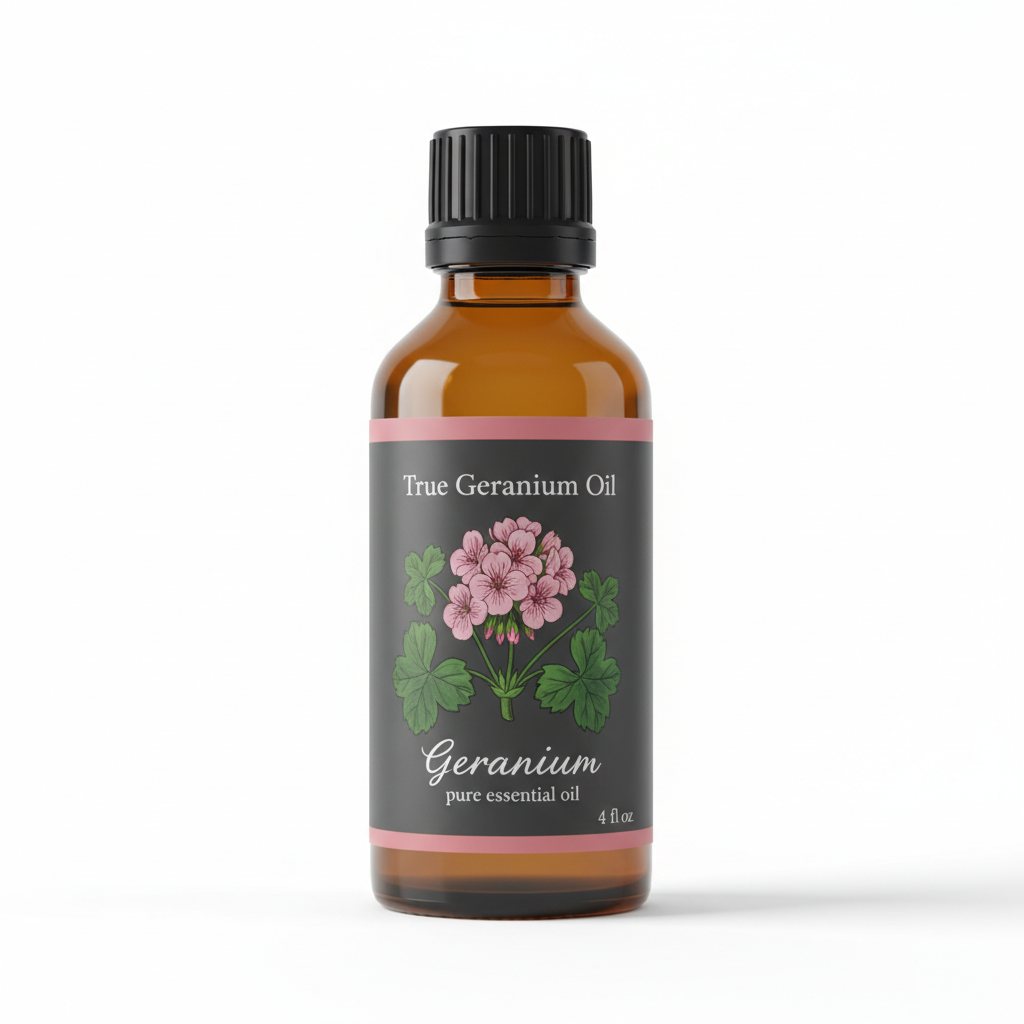
Geranium Essential Oil
Our own Geranium Essential Oil, in sizes from 0.5 oz to bulk.
From $15.99
Shop Now →When you search for how to buy geranium oil, you are almost certainly looking for one of several Pelargonium species. The most common in commerce are Pelargonium graveolens and its cultivar variants, along with Pelargonium roseum, the latter of which is typically sold under the name rose geranium. Understanding this distinction before you buy saves money and prevents disappointment.
The oil is produced by passing steam through harvested plant material. The steam carries volatile aromatic molecules, which then condense into the finished essential oil. Good distillation practice keeps temperatures low and collection times appropriate to the plant, preserving the more delicate rosy, green, and slightly minty facets that make geranium oil so prized in perfumery and cosmetic formulation.
Why the Botanical Name Is Your First Quality Check
A reputable supplier will always list the Latin binomial on the label or product page. If you see only the word "geranium" with no species designation, you have no way of knowing what you are actually buying. This is not a minor detail. Different species and even different cultivars within a species produce oils with noticeably different aromatic profiles and different chemical compositions.
Look for the full species name: Pelargonium graveolens, Pelargonium roseum, or Pelargonium x asperum (a common cultivar group). Some suppliers also list the chemotype or cultivar name, which is even more informative. If a supplier cannot or will not provide this, move on.

The Main Types of Geranium Oil You Will Encounter
Walking through an online marketplace or natural cosmetics supplier catalog, you will see several names used interchangeably or with subtle distinction. Here is a clear breakdown of the types you are most likely to find when you set out to buy geranium essential oil.
Geranium Oil (Standard)
This label usually refers to oil distilled from Pelargonium graveolens or its cultivars. It is the workhorse of the category: widely available, reasonably priced, and produced in large volumes across Egypt, China, and Morocco. The scent is rosy, green, and slightly earthy. It is the default choice for cosmetic formulators, candle makers, and soap artisans who need consistent supply at manageable cost.
Rose Geranium Oil
Rose geranium is the name most commonly applied to oil from Pelargonium roseum or to certain cultivars of Pelargonium graveolens that produce a particularly high-rose aromatic character. The distinction in the marketplace is not always botanically precise. Some suppliers label oil "rose geranium" simply because it smells more rose-like than their standard geranium offering. Others use it to indicate a specific species.
For a deeper look at how these labels differ and when it matters, see our guide on rose geranium vs. geranium oil: same plant, different bottle.
Bourbon Geranium Oil
Bourbon geranium refers to oil produced on Réunion Island (historically called Île Bourbon). It is widely regarded as the benchmark for fragrance quality in this category. The climate and volcanic soils of Réunion produce an oil with exceptional clarity and a rounder, more complex rose character compared to many Egyptian or Chinese alternatives. It commands a higher price, which is generally justified for perfumery and premium cosmetic applications.
Egyptian Geranium Oil
Egypt is the world's largest producer of geranium oil by volume. Egyptian production centers on the Nile Delta region, where the growing conditions favor high yields. The scent profile tends to be slightly more herbaceous and green compared to Bourbon, though quality varies significantly between producers. It represents excellent value for formulation work where fragrance nuance is secondary to performance and consistency.
For a full comparison of these two major origins, including how to decide which suits your needs, read our article on Egyptian vs. Bourbon geranium oil: does origin change the rose.
Organic Geranium Oil
Organic geranium essential oil is produced from plants grown without synthetic pesticides or fertilizers, and certified through an accredited body. It is available in both Bourbon and Egyptian origins, as well as from smaller producers in Morocco and China. The organic designation matters most to formulators creating certified organic cosmetics, to practitioners who apply oils to skin at high frequency, and to buyers who prioritize supply chain ethics.
| Type | Primary Origin | Scent Character | Typical Use Case | Price Tier |
|---|---|---|---|---|
| Standard Geranium | Egypt, China, Morocco | Rosy, green, earthy | Formulation, soap, candles | Low to mid |
| Rose Geranium | Various | More pronounced rose | Perfumery, skincare | Mid |
| Bourbon Geranium | Réunion Island | Round, complex, floral | Fine fragrance, premium cosmetics | Mid to high |
| Egyptian Geranium | Egypt | Herbaceous, rosy | High-volume formulation | Low to mid |
| Organic Geranium | Egypt, Réunion, Morocco | Varies by origin | Certified organic products, skincare | Mid to high |
Origins and What They Actually Mean for Quality
Country of origin is one of the most meaningful data points on a geranium oil label, but it requires context to interpret correctly. Growing altitude, soil mineral content, rainfall patterns, harvest timing, and distillation practices all interact with geography to produce the final oil. Origin alone is not destiny, but it is a reliable starting point for expectation-setting.
Réunion Island (Bourbon)
Réunion produces smaller volumes of geranium oil than Egypt, which keeps supply tight and prices elevated. Growers on the island have generations of cultivated knowledge around harvest timing: the leaves are ideally picked in the early morning, and distillation happens quickly after cutting to minimize aromatic loss. The resulting oil is consistently cited by perfumers as having a superior rose top note and a cleaner dry-down. If your application is fragrance-forward, Bourbon is worth the premium.
Egypt
Egypt produces the majority of the world's geranium oil supply. Volume is both its strength and its complexity. With many producers operating at different quality levels, Egyptian geranium oil is not a monolithic category. Premium Egyptian producers investing in proper distillation equipment and post-harvest care can produce oils that rival Bourbon in aromatic clarity. Budget producers cutting corners on distillation time or water quality deliver a noticeably inferior product. When buying Egyptian geranium oil, supplier transparency is everything.
Morocco
Moroccan geranium oil production has grown steadily over recent decades. The mountain-grown crops of the High Atlas region benefit from altitude and temperature variation, producing oils with a pleasing freshness. Moroccan geranium tends to sit between Egyptian and Bourbon in aromatic character and price, making it an interesting middle option for formulators exploring alternatives.
China
Chinese geranium oil is the most affordable on the market by a significant margin. Quality varies enormously. Some Chinese producers have invested heavily in modern distillation and quality control, and their oils perform well in formulation. Others produce oils that have been extended or processed in ways that compromise aromatic integrity. GC/MS testing from a reputable third party is especially important when evaluating Chinese-origin geranium oil.
A Note on Small-Batch and Artisan Origins
A small but growing number of producers in South Africa (the pelargonium's native range), Madagascar, and parts of Europe are distilling geranium oil in small batches. These oils are often expensive and supply is irregular, but they can offer aromatic profiles quite different from commercial norms. Worth exploring once you have a reference point for what quality geranium oil should smell and feel like.

How to Read a Label and Spot Quality Markers
Learning to read an essential oil label is a skill that pays off across every purchase. For geranium oil specifically, here are the markers that distinguish a trustworthy product from a gamble.
The Latin Binomial
Already mentioned above, but worth emphasizing: the full botanical name is non-negotiable. Pelargonium graveolens, Pelargonium roseum, or Pelargonium x asperum should appear on the label or immediately accessible product documentation. If it does not, the supplier either does not know what they are selling or has chosen not to disclose it. Neither is acceptable for a quality product.
Country of Origin
The country where the plant was grown (not where the oil was bottled) should be clearly stated. Bottling country and production country are not the same thing. An oil grown in Egypt, bottled in the UK, and sold by a US retailer should still clearly state Egypt as the origin on its label or spec sheet.
Distillation Method
Look for "steam distilled" as the extraction method. Geranium oil produced by other methods (solvent extraction, CO2 supercritical extraction) will have different chemical profiles and different applications. Steam distillation is the standard for cosmetic and aromatic use.
GC/MS Testing
Gas chromatography/mass spectrometry (GC/MS) testing is the gold standard for verifying essential oil composition. A reputable supplier will either publish GC/MS reports for each batch or make them available on request. These reports show the percentage breakdown of each chemical constituent in the oil, allowing you to confirm that what you have received matches what geranium oil should contain. Key constituents to expect in a quality geranium oil include citronellol, geraniol, linalool, and geranyl formate, among others.
Some suppliers publish summarized constituent ranges rather than full batch reports. This is better than nothing, but full batch-specific reports are the superior standard.
Batch Number and Lot Tracking
Batch numbers on the label or packaging indicate that the supplier tracks individual production runs. This matters for two reasons. First, it allows you to request the specific test data for your bottle. Second, it signals that the company has quality control infrastructure, not just a single bulk purchase being decanted indefinitely.
Specific Gravity and Refractive Index
Some suppliers include physical property data such as specific gravity and refractive index alongside GC/MS data. These measurements serve as additional verification that the oil matches established reference ranges. They are a mark of professional-grade quality documentation rather than a consumer-facing necessity, but their presence is reassuring.
Scent as a Quality Signal
Experienced buyers develop an olfactory reference for quality geranium oil. A fresh, rosy, slightly green and minty opening with good diffusive lift is what you are looking for. An oil that smells flat, musty, or predominantly synthetic-rosy (a common sign of adulteration with synthetic citronellol or rose oxide) is not meeting the standard. If a supplier offers samples, buy one before committing to a larger bottle. The nose remains one of the most reliable instruments in this category.
Certifications: Which Ones Matter and Which Are Noise
The essential oil market is crowded with certification badges and quality claims. Some carry real weight. Others are marketing constructs with little independent verification behind them. Here is a straightforward guide to evaluating what you see.
USDA Organic
For buyers in the United States, the USDA National Organic Program (NOP) certification is the most rigorous and independently verified organic standard. It requires third-party inspection of growing and handling practices, with documented audit trails. If you are formulating cosmetics that you intend to label as organic or natural, USDA certified organic geranium essential oil is the most defensible choice.
ECOCERT and COSMOS
For European markets, ECOCERT and the COSMOS standard (which includes COSMOS Organic and COSMOS Natural) are the most recognized certifications. COSMOS is particularly relevant to cosmetic formulators, as it was developed specifically to address ingredient standards in personal care products. An oil holding a COSMOS Organic certification has been produced to standards compatible with most European organic cosmetics labeling requirements.
ISO Standards
The International Organization for Standardization publishes ISO specifications for many essential oils, including geranium (ISO 4731). These specifications define acceptable ranges for physical properties and constituent percentages. An oil described as "ISO compliant" has been verified to meet these reference ranges. ISO compliance does not address organic status or sustainability, but it does confirm that the oil is within expected quality parameters for the species.
Proprietary "Therapeutic Grade" Claims
Several essential oil brands use trademarked grade designations that imply superior quality or special properties. These designations are proprietary marketing terms created by individual companies. They do not correspond to any independent government standard or third-party certification body. Evaluate these brands on the same criteria as any other supplier: GC/MS documentation, botanical labeling, origin transparency, and certifier identity. The presence of a proprietary grade label neither adds to nor subtracts from actual oil quality.
Fair Trade Certification
Fair trade certification is not a quality marker for the oil itself, but it is a meaningful signal about supply chain ethics. Geranium cultivation in Egypt and Réunion involves agricultural labor, and fair trade certification provides some assurance that workers have received fair wages and that environmental standards have been observed. If supply chain ethics matter to your purchasing decisions, look for Fairtrade or Fair for Life certification alongside quality documentation.
A note on "100% pure" claims: Nearly every essential oil on the market carries this phrase. It is essentially meaningless without supporting documentation, because it is self-declared and unverified. A GC/MS report from an independent laboratory is what "100% pure" actually looks like in practice.
Where to Buy Geranium Essential Oil
The channel through which you buy geranium oil affects price, documentation access, freshness, and the reliability of what you receive. Each option has genuine trade-offs worth understanding.
Specialty Essential Oil Retailers (Online)
Dedicated essential oil retailers, whether small independent operations or larger established brands, represent the most reliable channel for documented, properly labeled oils. The best of these companies publish GC/MS batch reports on their websites, list full botanical information, and maintain transparent sourcing relationships. They often offer multiple origins and size options, making them suitable for both first-time buyers and experienced formulators.
The trade-off is price: specialty retailers charge more than general marketplaces, partly to cover the cost of quality documentation and proper storage infrastructure. For most buyers, this premium is worth paying. A cheap oil of unknown origin and composition is not a bargain if it does not perform or if it contains adulterants.
Direct from Distillers
Buying directly from the distillery offers the most direct access to provenance information and often the freshest possible oil. Some Egyptian and Réunion distillers sell direct to international buyers, particularly for larger quantities. The challenge is verification: it can be difficult to assess a distillery's quality standards without visiting or having an established relationship. If you find a distillery with published testing data and traceable production information, direct purchasing can be an excellent option, particularly for bulk needs.
For those considering larger quantities, our guide on wholesale geranium oil: bulk sizes, origins, and pricing covers what to expect when scaling up your purchase.
General Online Marketplaces
Platforms like Amazon, eBay, and similar marketplaces carry a vast range of geranium oil products, from excellent to very poor. The main risk is the difficulty of verifying claims. Third-party sellers on these platforms are not always held to consistent standards of labeling or documentation. If you do buy from a general marketplace, prioritize brands that direct you to published GC/MS reports and that carry recognized certifications. Read reviews critically and prioritize reviewers who describe their experience with specificity rather than generality.
Natural Food Stores and Co-ops
Brick-and-mortar natural food stores carry a curated selection of essential oils, usually from a small number of established brands. The advantage here is the ability to smell before you buy, which is genuinely valuable for an aromatic product. The disadvantage is limited selection and, often, limited documentation available in-store. If you find a brand you like through a physical retailer, investigate their documentation online before making it your regular source.
Aromatherapy and Cosmetic Ingredient Suppliers
Suppliers who specialize in raw ingredients for cosmetic formulation often carry geranium oil alongside carrier oils, butters, and other actives. These suppliers cater to professional formulators and tend to maintain rigorous documentation standards, because their customers depend on ingredient consistency. For anyone formulating products at scale, this channel is worth exploring.
For a channel-by-channel breakdown with specific considerations for each retail environment, see our guide on where to buy rose geranium oil: shops, labels, and checks.
Bottle Sizes, Pricing, and Getting the Best Value
Geranium oil is sold in sizes ranging from 5 mL sample vials to 1-kilogram bulk quantities. Choosing the right size for your situation is a practical decision that affects both cost-per-mL and product freshness.
Starting Small: 5 mL to 15 mL
If you are buying geranium essential oil for the first time, or trying a new supplier or origin for the first time, starting with a 10 mL or 15 mL bottle is sound practice. The investment is modest, and you have enough oil to evaluate the scent, assess how it performs in your intended application, and decide whether the source is worth returning to.
Small bottles also make sense for perfumery work where you are using geranium as one note among many and consumption is measured in drops per formula.
The Everyday Range: 30 mL to 100 mL
For regular personal use, small-scale formulation, or a household where geranium oil features in multiple applications, the 30 mL to 100 mL range delivers better value per mL than smaller sizes without exposing you to the freshness risk of very large containers. A 30 mL bottle of geranium oil, stored correctly in a cool dark location, will maintain its aromatic integrity comfortably within a typical use period.
Larger Sizes: 500 mL and Above
Serious formulators, soap makers, and candle producers will find that buying geranium oil in 500 mL or larger quantities reduces per-unit cost meaningfully. The key consideration is storage: larger containers should be decanted into smaller working bottles to minimize oxidation exposure, and the bulk stock should be kept cool, away from light, and properly sealed.
Bulk purchasing also opens access to wholesale pricing structures that are not available at retail. For a detailed look at how to approach this, read our article on wholesale geranium oil: bulk sizes, origins, and pricing.
Understanding Price Ranges
| Oil Type | 10 mL | 30 mL | 100 mL |
|---|---|---|---|
| Standard Egyptian Geranium | $5 to $12 | $12 to $28 | $30 to $65 |
| Organic Egyptian Geranium | $10 to $18 | $22 to $45 | $55 to $100 |
| Bourbon Geranium (Réunion) | $15 to $30 | $35 to $75 | $90 to $180 |
| Organic Bourbon Geranium | $20 to $40 | $50 to $95 | $120 to $220 |
These ranges are indicative and fluctuate with harvest conditions, global shipping costs, and currency movements. Significantly below these ranges should prompt questions about documentation and adulteration. Significantly above them should prompt questions about what specifically justifies the premium.
For a dedicated analysis of how bottle size affects value and which size makes sense for different use cases, see our guide on best geranium oil sizes: which bottle should you order first.
Is Geranium Oil a Good Value Compared to Rose Otto?
Rose otto (distilled from Rosa damascena) is one of the most expensive essential oils in existence, often priced at several hundred dollars per milliliter for genuine material. Geranium oil shares many of rose otto's key aromatic characteristics at a fraction of the cost. For formulators and perfumers working within a budget, understanding this relationship is valuable.
For an honest, detailed comparison of these two oils, including where geranium genuinely excels and where it cannot replicate rose otto, read geranium vs. rose otto: the honest case for the affordable.
Red Flags: Signs a Geranium Oil Is Not Worth Your Money
Knowing what to avoid is as useful as knowing what to seek. The following signals should prompt you to look elsewhere, regardless of how appealing the price or packaging might be.
No Botanical Name on the Label
If a product is labeled simply "Geranium Essential Oil" with no Latin species name, the supplier is not meeting basic transparency standards. This is the most common quality shortcut in the mass market. Walk away.
Missing or Unavailable Test Data
Any supplier unwilling or unable to provide GC/MS documentation on request is not operating at a professional quality level. Reputable suppliers understand that buyers need this information and provide it without friction. "We test all our oils" without access to actual reports is not an acceptable substitute.
Price That Seems Too Good
Genuine geranium oil, particularly Bourbon origin or certified organic, has real production costs associated with it. If a price is dramatically lower than market norms, the oil is almost certainly adulterated, diluted in a carrier oil without disclosure, or simply misrepresented. This is not about brand premium; it is about the basic economics of distillation, certification, and proper cold-chain handling.
"Fragrance Oil" Language Mixed with "Essential Oil" Claims
Fragrance oils are synthetic or semi-synthetic aromatic compounds designed to mimic natural scents. They are not essential oils. Some sellers use confusing language that blurs this distinction, particularly for rose-type scents where synthetic alternatives are common. Read ingredient lists carefully. If the only listed ingredient is "geranium essential oil" but the price is suspiciously low and documentation is absent, you may have a fragrance oil masquerading as something else.
Oily Texture Without Disclosure
Pure geranium essential oil is not oily in texture. It is a light, mobile liquid that evaporates quickly when a drop is placed on paper. If your "geranium oil" feels greasy or leaves a permanent oil stain on paper, it has been diluted in a carrier oil. This is not inherently problematic if the supplier discloses it, but undisclosed dilution in a product sold as "pure" is adulteration.
Sealed Packaging with No Batch Information
Batch tracking is the foundation of traceability. A product with no batch number, no distillation date, and no expiry or best-before guidance has not been produced with quality control in mind. Fresh geranium oil is aromatic and lively. Oil of unknown age sitting in a warehouse for an undetermined period is a different product, even if the species and origin are correctly stated.
Exaggerated Attribute Claims
Be cautious of any seller making sweeping claims about what their geranium oil can do beyond its aromatic and cosmetic context. An oil that is positioned primarily on the basis of extraordinary properties rather than on transparent sourcing, documented composition, and quality distillation practice is prioritizing marketing over substance.
No Return or Sample Policy
Confident suppliers stand behind their product. A company that offers no sample size option and no return policy for quality concerns is not acting in good faith. Given that scent is inherently subjective and sourcing varies batch to batch, some mechanism for buyers to evaluate the product before full commitment is a mark of professional practice.
Putting It All Together: A Practical Buying Checklist
Before you complete any purchase of geranium essential oil, run through this checklist. It takes under two minutes and will save you the frustration of receiving an oil that does not meet your needs.
- Is the Latin species name clearly listed? (Pelargonium graveolens, Pelargonium roseum, or Pelargonium x asperum)
- Is the country of origin specified (not just the bottling country)?
- Is the extraction method identified as steam distillation?
- Is a GC/MS report available for this specific batch, either published or on request?
- If organic is claimed: which certification body verified it, and is the certifier name on the label?
- Is there a batch number allowing you to trace the product?
- Is the price within a reasonable range for this type and origin?
- Does the supplier offer samples or a quality guarantee?
Eight checkboxes. If you can tick all eight, you have found a supplier operating at a professional standard. If you can tick six or seven, proceed with reasonable confidence. Fewer than six should prompt either further investigation or a different supplier entirely.
Buying the best geranium essential oil for your needs does not require expert-level knowledge of plant chemistry. It requires asking the right questions and recognizing when a supplier has the answers. The transparency signals described throughout this guide are all reasonable expectations for a well-run essential oil business. When those signals are present, you can buy with confidence.