
Rose Geranium vs Geranium Oil: Same Plant, Different Bottle?
Walk into any natural beauty shop or browse a reputable essential oil supplier, and you will almost certainly find two labels sitting side by side: geranium oil and rose geranium essential oil. The price difference can be surprising. So can the scent difference. And yet the botanical name printed on both bottles is often identical: Pelargonium graveolens. What is actually going on here?
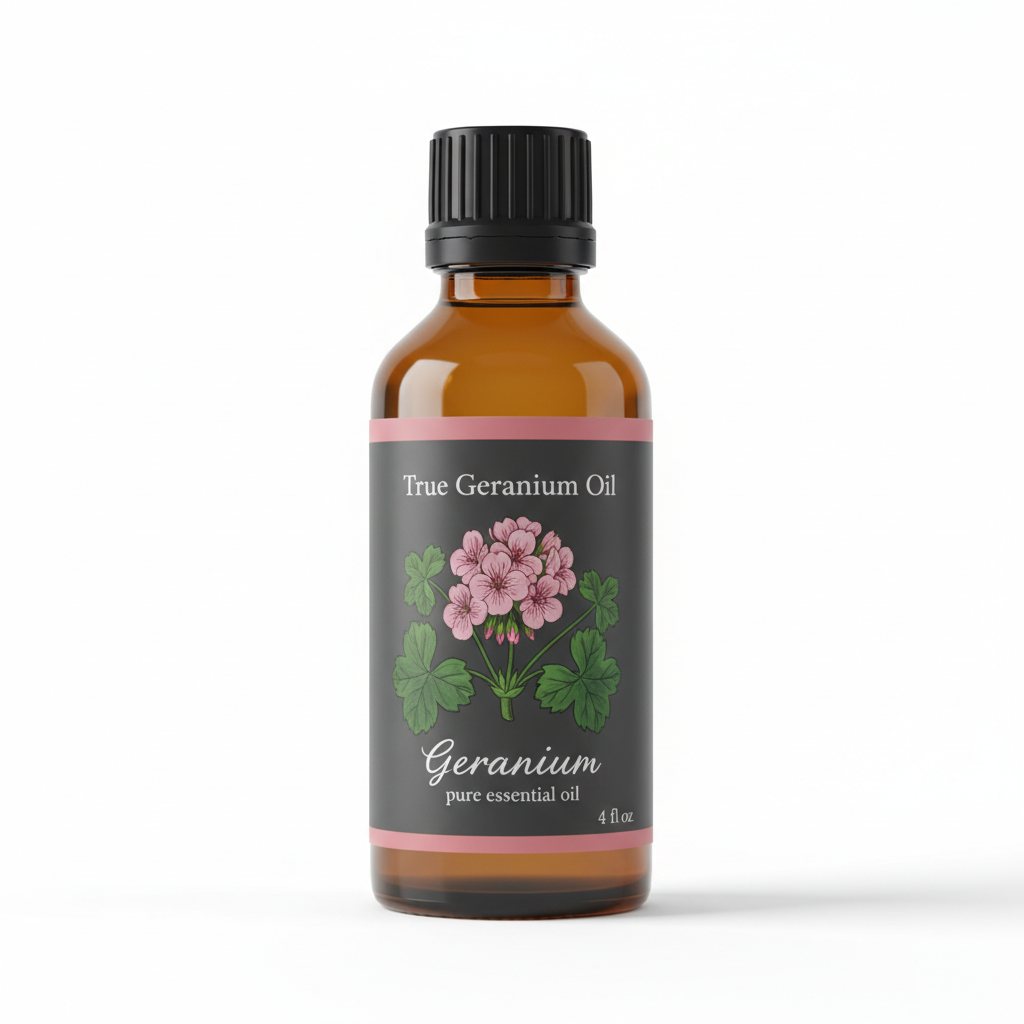
Geranium Essential Oil
Our own Geranium Essential Oil, in sizes from 0.5 oz to bulk.
From $15.99
Shop Now →This guide untangles the confusion with honest, practical information. We will look at where these oils come from, how their scent profiles differ, what the chemistry tells us, and which option makes the most sense depending on how you plan to use it. No hype, no inflated claims. Just a clear-eyed comparison to help you spend your money wisely.
First, a Botany Lesson Worth Two Minutes
All commercial geranium oil comes from the genus Pelargonium, not true geraniums. The plants are scented-leaf shrubs cultivated primarily for their aromatic foliage, not their flowers. Several species and hybrids contribute to the trade, and the naming conventions have never been perfectly standardized across the industry.
Geranium oil is the broad category. It covers distillations from Pelargonium graveolens and related cultivars grown across Egypt, Morocco, China, India, and the island of Réunion (historically known as Bourbon). The scent is green, rosy, and slightly earthy, with noticeable citrus undertones depending on origin.
Rose geranium essential oil is more specific. It generally refers to oil from Pelargonium graveolens var. roseum or from select cultivars whose chemical profile leans heavily toward the rose-like compounds citronellol and geraniol. The result is a softer, sweeter, noticeably more floral scent that many people describe as sitting somewhere between a garden rose and a green herbal note.
Crucially, neither label is wrong. The confusion arises because some producers use "rose geranium" loosely as a marketing description for any pleasantly floral geranium oil, while others use it precisely to indicate a specific cultivar or chemical standard. This is why reading a full GC/MS report (gas chromatography/mass spectrometry) matters more than reading the label alone. For a deeper look at navigating these distinctions before you buy, see our complete guide to buying geranium oil and understanding its types.
The Scent: Where the Real Difference Lives
Fragrance is the most immediately noticeable difference, and for most home users it is also the most important one.
Standard geranium oil tends to be assertive. It has a green, slightly medicinal quality on first contact, followed by a rosy heart and a dry, mildly earthy drydown. It blends boldly with citrus, wood, and spice notes. Perfumers often reach for it when they want presence and projection.
Rose geranium essential oil opens more gently. The rose-like character comes forward immediately, with less of the sharp green edge. The drydown is sweeter and longer-lasting on skin. Many people find it more approachable as a single-note diffuser oil or skin-care additive, because it does not compete as aggressively with other ingredients in a blend.
This difference is not imaginary, but it is also not absolute. A high-quality Egyptian geranium can smell remarkably close to a rose geranium from the same distiller if the cultivar and harvest conditions are right. Conversely, a poor-quality rose geranium can smell thin and synthetic. Origin and distillation quality shape the scent as much as the varietal name does.
The Chemistry: What GC/MS Reports Reveal
Both oils share a large family of chemical constituents. The proportions, however, shift in meaningful ways.
Key Constituents in Standard Geranium Oil
- Citronellol: typically 20 to 35 percent, contributing the rosy, slightly citrusy character
- Geraniol: typically 10 to 20 percent, adding sweetness and floral depth
- Linalool: usually 5 to 12 percent, softening the overall profile
- Isomenthone: can reach 5 to 10 percent, responsible for the green, minty-herbal edge
- Geranyl formate and geranyl tiglate: minor esters that contribute fruity nuance
Key Constituents in Rose Geranium Essential Oil
- Citronellol: often 35 to 45 percent or higher, giving a pronounced rosy lift
- Geraniol: typically 15 to 25 percent, increasing the sweet floral impression
- Linalool: similar or slightly higher range
- Isomenthone: noticeably lower, often under 5 percent, which is why the green edge is softer
- Rose oxide: a trace compound present in some rose geranium cultivars that adds a subtle, watery rose character
In short: rose geranium essential oil tilts toward higher citronellol and geraniol, lower isomenthone. That single shift accounts for most of the scent difference you perceive.
Side-by-Side Comparison Table

| Attribute | Geranium Oil | Rose Geranium Essential Oil |
|---|---|---|
| Botanical source | Pelargonium graveolens and related cultivars | Pelargonium graveolens var. roseum or high-rose cultivars |
| Scent character | Green, rosy, earthy, slightly sharp | Soft, sweet, rosy, floral, gentle drydown |
| Citronellol content | 20 to 35 percent (typical) | 35 to 45 percent or higher (typical) |
| Isomenthone content | 5 to 10 percent (adds green note) | Under 5 percent (softer profile) |
| Price range | Generally lower to mid-range | Generally mid to premium |
| Blending behavior | Bold, good projection, versatile in complex blends | Softer, more skin-forward, blends gently |
| Best documented origins | Egypt, Morocco, China, India | Réunion (Bourbon), South Africa, select Egyptian farms |
| GC/MS traceability | Should be available from reputable suppliers | Essential for confirming rose geranium profile |
| Typical cosmetic uses | Blends, diffusing, hair care, soap making | Skin care, perfumery, body oils, facial serums |
Pros and Cons: An Honest Look at Each
Geranium Oil: Pros
- More widely available and usually more affordable per milliliter
- Excellent versatility in complex fragrance blends where a green, rosy note is needed
- Strong projection in diffusers and room sprays
- Well-suited to soap and candle making, where the bolder character holds up through the process
- Easier to find from multiple vetted suppliers, giving you more sourcing options
Geranium Oil: Cons
- The green, sometimes sharp opening note can feel medicinal to sensitive noses
- Higher isomenthone content may not suit every skin-care blend where a softer scent is wanted
- Significant quality variation across origins, meaning a low-cost bottle may disappoint
- The "geranium" label covers a wide chemical range, so you need GC/MS data to know what you are actually buying
Rose Geranium Essential Oil: Pros
- The sweeter, more explicitly floral scent is widely perceived as more wearable on skin
- Higher citronellol and geraniol content aligns with the profile that some research observers associate with rosy fragrance quality
- A popular choice for natural perfumery as a more accessible alternative to costly rose otto (see our comparison: geranium vs rose otto, the honest case for the affordable option)
- Often preferred for facial and body care products where a gentle, lasting scent is the goal
- Bourbon-origin rose geranium, in particular, has a well-established reputation for consistent quality
Rose Geranium Essential Oil: Cons
- Higher price point, sometimes significantly so for authentic Bourbon-origin oil
- The label is not regulated, meaning some products sold as rose geranium may simply be standard geranium with a premium markup
- Requires more diligent sourcing verification, ideally with GC/MS reports confirming the elevated citronellol profile
- The softer scent can get lost in heavily fragranced blends where a bolder note is needed
How Origin Shapes Both Oils
Origin matters enormously in this category. An Egyptian geranium and a Bourbon rose geranium can smell like different oils entirely, even if both labels say Pelargonium graveolens. Soil composition, altitude, rainfall patterns, and distillation practices all leave their mark on the finished oil.
Bourbon oil from the island of Réunion has the longest fine-fragrance reputation. It tends toward a rounder, more complex rose character with excellent staying power. Egyptian geranium is the workhorse of the industry: high volume, generally reliable, and quite affordable. Chinese and Indian distillations vary widely. South African rose geranium has been gaining ground with quality-focused buyers in recent years.
Understanding how origin shapes character is worth spending time on before you commit to a supplier. Our comparison of Egyptian vs Bourbon geranium oil goes into this in much more detail.
Best For: Matching the Oil to the Use Case

Best for Soap Making and Candles
Standard geranium oil. The bolder scent holds better through saponification and the heat of candle pouring. The price advantage also matters when you are using larger quantities.
Best for Facial and Body Serums
Rose geranium essential oil. The softer, sweeter character sits more gracefully on skin. If the scent of your finished product is important to you or your customers, the premium is usually worth it here.
Best for Diffusing in Living Spaces
Either, depending on preference. For a bright, green-rosy atmosphere, standard geranium delivers well. For a softer, more floral mood in a bedroom or personal space, rose geranium essential oil is often the more pleasing choice.
Best for Natural Perfumery
Rose geranium essential oil for heart notes and skin-scent blends. Standard geranium for accords where you want a green or earthy rose character to add complexity to a larger composition.
Best for Hair Care Products
Standard geranium oil is the more practical choice here. Its projection works well in rinse-off products where the scent needs to be noticeable but not overwhelming, and the cost savings add up when you are using it in shampoos or conditioners at scale.
Best for First-Time Buyers
Standard geranium oil from a reputable supplier with a GC/MS report. It gives you a solid introduction to the scent family at a lower financial risk. Once you know what you like, you can decide whether the rose geranium premium makes sense for your specific needs.
A Note on Finding the Best Rose Geranium Essential Oil
If you have decided that rose geranium is the right choice for your project, the sourcing question becomes critical. Because the label is not regulated, the best rose geranium essential oil is not necessarily the most expensive one or the one with the most appealing packaging. It is the one backed by verifiable chemistry.
Look for these indicators when evaluating a supplier:
- A full GC/MS report specific to the batch you are buying, not a generic template
- Citronellol content at or above 35 percent as a reasonable benchmark for a genuinely rose-forward profile
- Clearly stated origin, including the country and ideally the farm or distillery
- Steam distillation as the extraction method (solvent extraction produces an absolute, not an essential oil)
- Transparent return or sampling policy, which signals a supplier confident in their product
Some of the most consistent rose geranium essential oil benefits in a cosmetic context come not from any single origin, but from the combination of a well-matched cultivar and a careful distiller. That relationship is worth investigating before you settle on a regular supplier.
The Verdict
Rose geranium and standard geranium oil come from the same botanical family, but they are not the same product. The difference is real and measurable in the chemistry. It is also immediately perceptible to anyone who smells them side by side.
Neither oil is inherently superior. Standard geranium is an excellent, versatile, and cost-effective choice for most blending, household, and high-volume applications. Rose geranium essential oil earns its premium in contexts where scent refinement matters most: skin-facing products, natural perfumery, and situations where a softer, more explicitly floral character is the goal.
The single most important thing you can do, regardless of which oil you choose, is buy from a supplier who shows their work. A GC/MS report turns a marketing label into a verifiable product. Without it, you are trusting a name rather than a substance.
If you are still deciding where to start, our complete buyer's guide to geranium oil types walks through every major variable, from species and cultivar to origin and distillation method, so you can shop with confidence rather than guesswork.