
Citronellol and Geraniol: The Rosy Chemistry of Geranium Oil
Open a bottle of true geranium oil and the scent hits you immediately: green, rosy, faintly sweet, with a complexity that neither rose nor mint quite captures alone. That character is not accidental. It is built, molecule by molecule, from a precise biochemical cocktail that the Pelargonium graveolens plant assembles in its glandular leaf hairs. Two compounds sit at the center of that cocktail: geraniol and citronellol. Understanding them is the fastest route to understanding geranium oil chemistry as a whole.
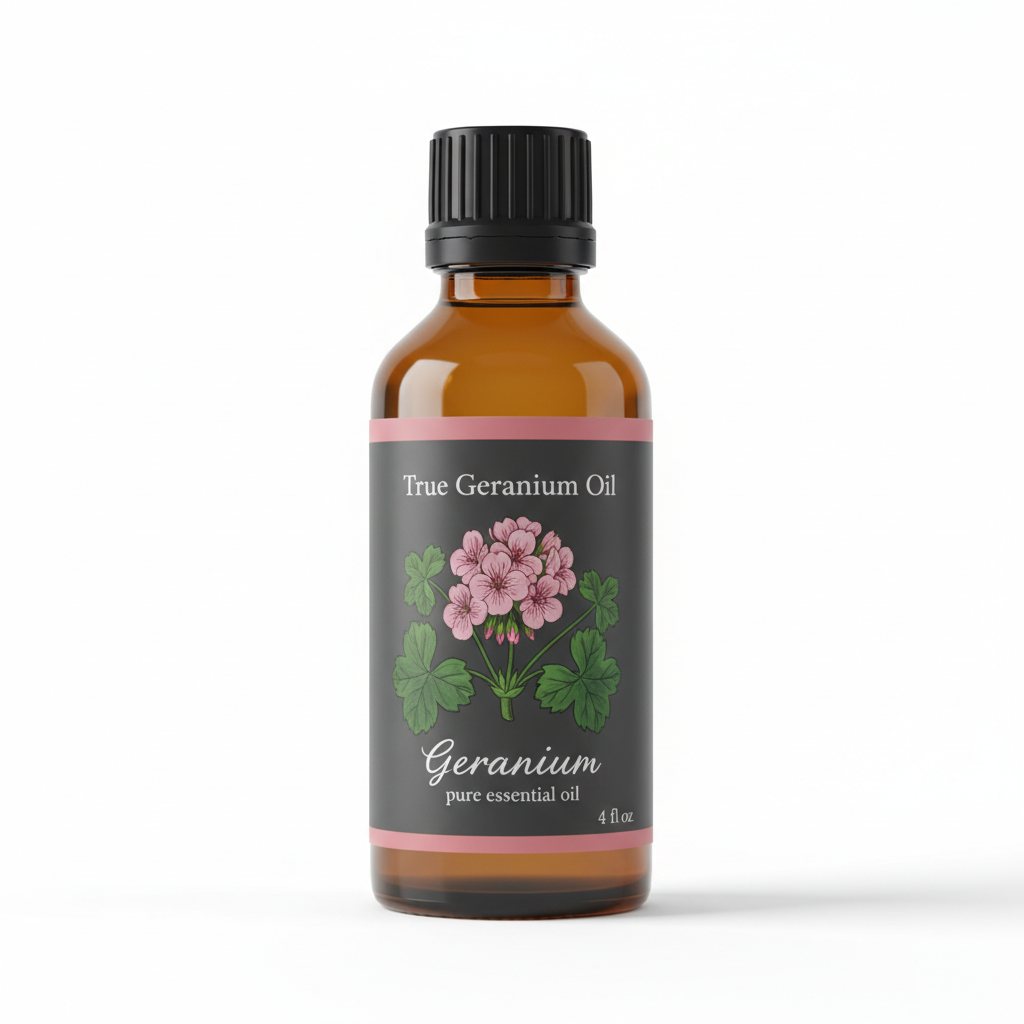
Geranium Essential Oil
Our own Geranium Essential Oil, in sizes from 0.5 oz to bulk.
From $15.99
Shop Now →This deep dive works through what these molecules are, what researchers have observed about them, how their ratios signal quality, and what every user should know about safe handling. If you are new to geranium oil and want broader context first, the complete guide to geranium oil is a good place to start.

The Building Blocks: A Quick Primer on Monoterpenoids
Geraniol and citronellol both belong to a chemical family called monoterpenoids. Monoterpenoids are ten-carbon molecules assembled by plants from two five-carbon isoprene units. They are volatile, meaning they evaporate readily at room temperature, which is exactly why essential oils smell the way they do.
Within that family, geraniol and citronellol are classified as acyclic monoterpene alcohols. Acyclic means their carbon skeleton is a straight or branched chain with no ring structure. The alcohol designation refers to the hydroxyl group (OH) attached to the chain. That OH group matters: it makes these molecules more water-soluble than their hydrocarbon relatives, and it contributes significantly to how they interact with skin and scent receptors.
A useful way to picture the relationship between the two: citronellol is essentially a partially reduced form of geraniol. Geraniol carries a double bond in its carbon chain that citronellol does not. That structural difference changes the scent profile noticeably. Geraniol reads as floral and rosy. Citronellol is softer, slightly waxy, with a hint of rose-petal freshness that perfumers sometimes describe as cleaner or more diffuse.
Geranium Oil Constituents: What the Numbers Say
Gas chromatography-mass spectrometry (GC-MS) analysis of Pelargonium graveolens oils consistently identifies geraniol and citronellol as the dominant alcohols, together accounting for a substantial share of the total oil composition. Published analyses place combined citronellol and geraniol content typically between 40% and 65% of the total oil, though exact figures vary with cultivar, growing region, harvest timing, and distillation method.
A well-regarded 2011 study published in the Natural Product Communications journal analyzed Reunion Island geranium oils and found citronellol concentrations ranging from roughly 18% to 37%, with geraniol ranging from around 10% to 20%. These ranges illustrate just how variable even high-quality oils can be. The history of geranium oil production on Reunion Island helps explain why that island's oils became the global benchmark: the volcanic soil and climate consistently push the plant toward high alcohol content.
Beyond geraniol and citronellol, a full GC-MS profile of quality geranium oil typically reveals:
- Citronellyl formate: an ester formed from citronellol and formic acid, contributing a fruity, floral top note
- Geranyl formate: similarly formed from geraniol, adding sweet, rosy facets
- Linalool: a softer floral alcohol also found in lavender and coriander
- Isomenthone: a ketone that contributes the faintly minty, herbaceous edge characteristic of the Bourbon type
- 10-epi-gamma-eudesmol: a sesquiterpene alcohol linked to the oil's earthy, woody base notes
- Guaia-6,9-diene: a sesquiterpene hydrocarbon present in smaller quantities but identifiable in authentic oils
The esters (citronellyl formate and geranyl formate) deserve particular attention. Their presence in balanced proportions is considered a quality marker by experienced evaluators. An oil very high in free alcohols but low in corresponding esters may indicate over-distillation or adulteration with isolated citronellol or geraniol.

What Research Has Observed
Researchers have investigated geraniol and citronellol extensively, often as isolated compounds rather than within whole geranium oil. It is important to read those findings carefully: observations made on isolated molecules in laboratory settings do not automatically translate to outcomes from topical or aromatic use of whole essential oils at normal concentrations.
With that framing firmly in place, here is what published research has noted:
Geraniol
Some research suggests geraniol interacts with certain cellular signaling pathways in ways scientists find worth studying further. A review published in Molecules (2017) summarized observations across multiple in vitro and animal studies, noting that geraniol appeared to influence oxidative stress markers and cellular membrane permeability in laboratory models. The authors were careful to state that extrapolating these findings to human use requires considerably more investigation.
Fragrance researchers have documented geraniol's potent olfactory profile extensively. It is used as a reference standard in perfumery and appears on the International Fragrance Association (IFRA) list of regulated compounds precisely because of its sensitization potential at higher concentrations. More on that in the safety section below.
Citronellol
Citronellol has attracted research attention in the context of insect deterrence. Several studies have observed that citronellol-containing formulations appear less attractive to certain insects than untreated controls, though researchers note that efficacy in field conditions varies considerably from controlled laboratory results.
Some in vitro studies have observed citronellol interacting with smooth muscle cell models and influencing ion channel activity in isolated tissue preparations. As with geraniol, these observations come from controlled laboratory conditions and should not be read as predictions of what happens when you apply diluted geranium oil to your skin.
Synergy Within Whole Oil
One recurring theme in essential oil research is that whole oils often behave differently from isolated constituents. The term researchers use is the "entourage effect," a hypothesis that minor constituents modulate or amplify the activity of dominant ones. Geranium oil's complex profile, with its dozens of identified compounds, makes it a subject of ongoing interest for this reason. Research here is preliminary, and drawing firm conclusions would go well beyond what the current evidence supports.
Quality Indicators: Reading Geraniol and Citronellol Content

For buyers and formulators, geranium oil constituents analysis is a practical tool. Here is what to look for:
| Compound | Expected Range in Quality Bourbon-Type Oil | Red Flag |
|---|---|---|
| Citronellol | 18% to 35% | Above 40% may indicate adulteration with synthetic citronellol |
| Geraniol | 10% to 22% | Very high geraniol with low ester content suggests added isolates |
| Citronellyl formate | 6% to 14% | Near-zero levels in an otherwise high-alcohol oil warrant scrutiny |
| Geranyl formate | 4% to 10% | Same concern as above |
| Isomenthone | 3% to 10% | Absence in claimed Bourbon types is unusual |
A reputable supplier will provide a GC-MS report with every batch. If a supplier cannot or will not share that documentation, that alone is useful information. Pricing is also a signal: genuine Pelargonium graveolens oil from Reunion or Egypt is not cheap to produce. Oils priced far below market rate for the variety deserve extra scrutiny.
Storage conditions affect the geraniol-to-citronellol ratio over time, because geraniol can oxidize into citronellol and other degradation products. An aged or poorly stored oil may show an unusual citronellol spike alongside signs of oxidation. This is one practical reason why storage matters as much as sourcing. The guide on how to store geranium oil properly covers the specifics of bottles, temperature, and expected shelf life.
Safety Profile and Contraindications
Geranium oil has a well-established safety record when used as directed, but several considerations deserve clear attention.
Skin Sensitization
Both geraniol and citronellol are listed by IFRA and the Scientific Committee on Consumer Safety (SCCS) as known contact allergens in finished products above certain concentrations. Geraniol in particular carries a formal allergen declaration requirement in the European Union for leave-on cosmetic products when it exceeds 0.01% in the finished formula, and 0.001% in rinse-off products.
For practical use of geranium essential oil:
- Dilute to 1% to 2% in a carrier oil for leave-on skin applications (that is roughly 6 to 12 drops per 30 ml of carrier)
- Always perform a patch test on a small area of inner arm skin before broad application, and wait 24 hours
- Those with known fragrance sensitivities should approach geranium oil with particular caution, as geraniol is one of the 26 declared fragrance allergens under EU cosmetics regulations
Pregnancy and Nursing
Use of essential oils during pregnancy is an area where caution is consistently advised by aromatherapy professional bodies. Consult a qualified healthcare provider before using geranium oil if you are pregnant, trying to conceive, or nursing.
Children
Essential oils should be kept away from young children. Professional aromatherapy guidelines generally recommend avoiding direct skin application of most essential oils on children under the age of two, and using significantly lower dilutions for older children than those appropriate for adults.
Oxidized Oil
As geraniol oxidizes with age, it produces compounds including geraniol epoxide and geranial that have a higher sensitization potential than fresh geraniol. This is a concrete reason to use fresh oil stored correctly and to avoid using oil that smells "off" compared to how it smelled when new.
General Guidance
Essential oils are not substitutes for professional medical advice. If you have a skin condition or health concern, speak with a qualified healthcare provider before incorporating any essential oil into your routine.
Putting the Chemistry to Work
Understanding geranium oil chemistry is not purely academic. Knowing that citronellol is softer and more diffuse while geraniol is more intensely rosy helps you predict how a given batch will behave in a blend. A high-geraniol oil will read as more overtly floral. A higher-citronellol profile will blend more seamlessly with green or woody notes.
For cosmetic formulators, the ester content matters too. Those citronellyl and geranyl formate molecules contribute lasting power in a formula; they are fixatives of sorts, anchoring the top notes longer than the free alcohols would on their own.
The geraniol-citronellol ratio also gives buyers a simple cross-check when reviewing GC-MS reports. In authentic Bourbon-type oils, citronellol typically leads geraniol by a meaningful margin. An oil where geraniol substantially outpaces citronellol without a corresponding ester richness may be worth investigating further before purchase.
Geranium oil's scent is one of nature's more complex achievements, and citronellol and geraniol are the two molecules doing most of the heavy lifting. Read the chemistry, request the documentation, and store your oil well. The quality of what ends up on your skin or in your diffuser follows directly from those three habits.