What Is Geranium Oil? The Complete Guide to the Rose Impersonator

Key Takeaways
- Geranium oil comes from Pelargonium graveolens, a South African shrub with no botanical relation to the garden geranium (Geranium species).
- Its rosy, green, slightly minty scent makes it one of the most valuable rose-adjacent materials in perfumery and aromatherapy.
- The primary aroma compounds are citronellol and geraniol, which are shared with genuine rose oil.
- Steam distillation of the leaves and stems, not the flowers, produces the oil.
- Major growing regions include Egypt, China, and the island of Réunion, each producing oils with distinct scent profiles.
- Proper dilution, patch testing, and storage are essential for safe use in skin and hair care routines.
- The oil is generally considered non-phototoxic, but always verify with your source's safety data.
- Pelargonium oil should not be used undiluted on skin or around pets without specialist guidance.
If you have ever picked up a bottle of essential oil labeled "geranium" and thought it smelled more like a rose than anything growing in your grandmother's garden, you are not imagining things. Geranium essential oil is one of the great botanical impersonators in the world of natural fragrance. Its scent borrows so convincingly from rose that perfumers have used it for centuries to stretch or substitute far more expensive rose absolute.
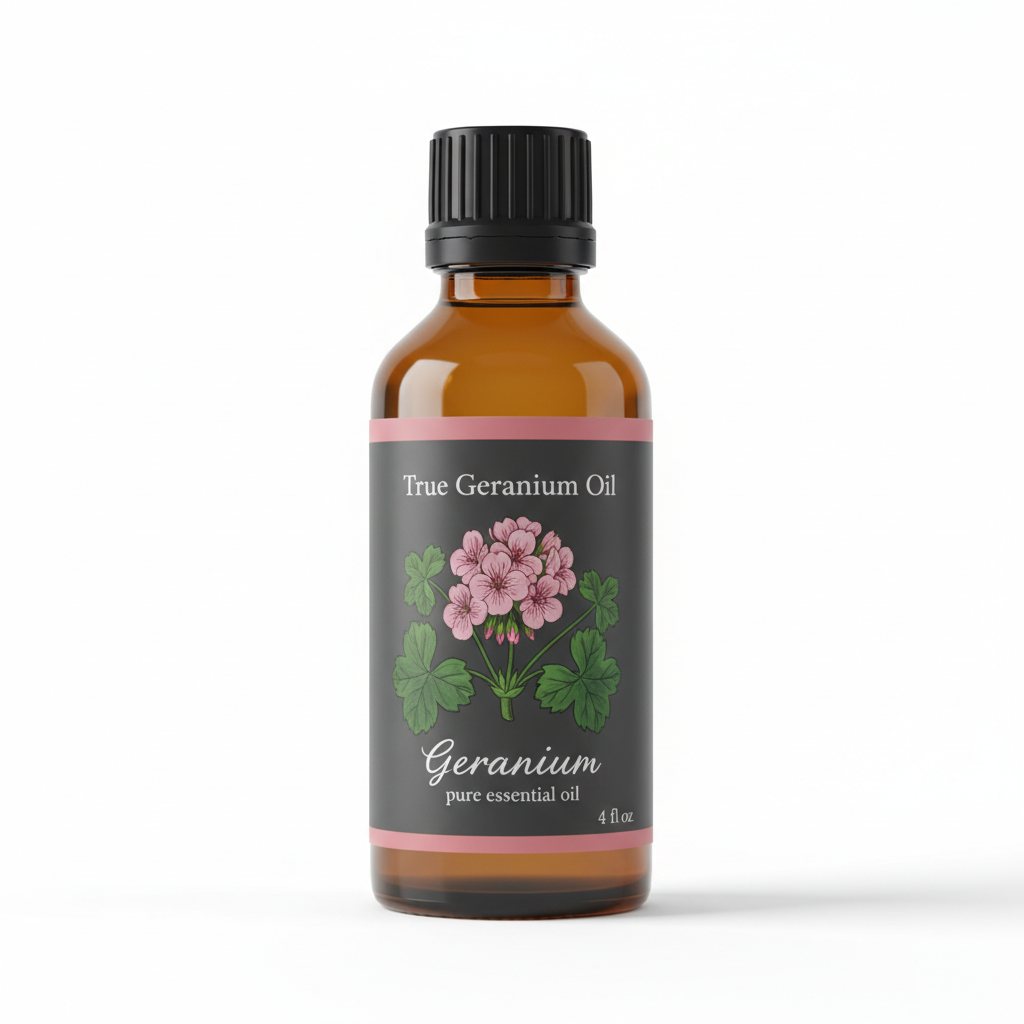
Geranium Essential Oil
Our own Geranium Essential Oil, in sizes from 0.5 oz to bulk.
From $15.99
Shop Now →But the story behind geranium oil is richer than a scent profile. The plant, its origins, the way the oil is extracted, and the chemistry driving that rosy character are all genuinely fascinating. This guide covers all of it: from the taxonomy dispute that trips up even seasoned botanists, to the practical information you need to choose a quality oil and use it confidently in your daily routines.
Whether you are new to essential oils or deepening an existing knowledge base, understanding what geranium oil actually is will help you buy smarter, blend better, and appreciate one of the most underrated materials in aromatic botany.
1. The Name Confusion: Geranium vs. Pelargonium
Let us get the naming issue out of the way first, because it underlies almost every piece of misinformation circulating about this oil.
When most people hear "geranium," they picture the familiar potted plant: the one with rounded leaves, a slightly sharp green smell when brushed, and clusters of cheerful red, pink, or white flowers. That plant belongs to the genus Geranium, a large group of plants in the family Geraniaceae commonly called cranesbills. True geraniums are native to temperate regions across the globe and are widely grown as garden perennials.
Geranium essential oil does not come from those plants.
It comes from Pelargonium, a related but distinct genus in the same family. Pelargonium species originated primarily in South Africa and were brought to Europe in the seventeenth century. For a long time, they were lumped together with Geranium in the botanical literature, and the common name "geranium" stuck, even after taxonomists formally separated the genera in 1789.
The result is a naming legacy that still causes confusion. Walk into any garden center and the potted plants labeled "geraniums" on the shelf are almost certainly Pelargonium hybrids. Pick up a bottle of geranium essential oil and you are looking at an extract from a specific fragrant Pelargonium species, not from the true botanical genus Geranium.
This distinction matters for several practical reasons:
- Safety data applies to the correct plant. Research and safety assessments for geranium oil specifically apply to Pelargonium species, not Geranium species. Conflating them leads to misapplied safety information.
- Botanical labeling reveals quality. A reputable supplier will include the Latin binomial on the label. "Pelargonium graveolens" or "Pelargonium x asperum" is what you want to see. If a label simply says "geranium" with no Latin name, that is a gap worth investigating before purchasing.
- The flowers are not the source. Unlike rose oil, which comes from petals, geranium oil is distilled from the leaves and green parts of the plant. The confusion about which plant is involved sometimes leads people to expect a floral extraction process that simply does not apply here.
"The popular name 'geranium oil' for the essential oil obtained from Pelargonium species is so deeply embedded in trade and commerce that efforts to rename it have made little headway. The botanically precise term would be 'pelargonium oil,' but 'geranium oil' remains the standard in the essential oil industry."
You will sometimes see the oil labeled as "Rose Geranium" oil. This typically refers to varieties or cultivars with a particularly pronounced rosy quality in the scent, though the term is used loosely across the industry and does not correspond to a single agreed botanical definition. We will revisit this distinction in the section on scent and in the section on growing regions.
2. Botanical Identity: What Plant Does Geranium Oil Actually Come From?
The genus Pelargonium contains over 280 species, ranging from succulents to sprawling shrubs. Only a handful are grown commercially for essential oil production. The primary source of commercial geranium oil is Pelargonium graveolens, along with its hybrids and close relatives.
Pelargonium graveolens: The Core Species
Pelargonium graveolens is a woody-stemmed perennial shrub native to the southwestern Cape region of South Africa. In its natural habitat, it grows in rocky, well-drained soils under conditions of moderate rainfall and strong sunlight. The species name graveolens means "strong-smelling" in Latin, which is an apt description. Brushing the leaves releases an immediate and complex green-rosy fragrance that is nothing like the sharp, slightly resinous smell of the common garden geranium.
The plant grows to roughly one meter in height under cultivation, producing small pink to pale lavender flowers and deeply lobed, soft leaves covered in fine hairs. Those hairs contain glands that hold the volatile aromatic compounds. When the plant is harvested and steam distilled, those compounds become geranium essential oil.
The Hybrid Question: Pelargonium x asperum
Much of what is sold commercially as geranium oil is not from pure Pelargonium graveolens but from a hybrid known as Pelargonium x asperum (sometimes written Pelargonium x roseum or listed under other synonyms). This hybrid, developed over centuries of cultivation and crossing, tends to be more productive and adaptable to agricultural conditions than the pure species.
The distinction between P. graveolens and P. x asperum is meaningful to botanists and quality specialists, but in everyday commerce the oils produced from both are typically sold under the same "geranium oil" label. The chemical composition and scent can differ somewhat between them, which is one reason why batch-to-batch variation exists even within the same origin country.
Other Pelargonium Species Used in Essential Oil Production
A few other Pelargonium species occasionally appear in the essential oil trade:
- Pelargonium capitatum: Sometimes called the "rose pelargonium," this species grows wild along South African coastal dunes and produces an oil with a notably rosy character.
- Pelargonium radens: A species with a harsher, more medicinal-green scent, sometimes blended into commercial geranium oil.
- Pelargonium odoratissimum: Known as the apple geranium for its fruity scent, it is rarely distilled for commercial oil on its own.
For the purposes of this guide, when we say "geranium oil," we mean oil derived from Pelargonium graveolens and its closely related hybrids, which constitute the vast majority of what reaches consumers.

Cultivation Basics
Pelargonium graveolens plants grown for distillation are typically propagated from cuttings rather than seed, which allows farmers to maintain consistent aromatic characteristics across generations of plants. The crop prefers well-drained, slightly sandy soils and does not tolerate waterlogging. In commercial growing operations, plants are harvested two to three times per year, cutting the stems and leaves above the woody base to allow regrowth.
Because aroma compound concentrations vary with time of day, season, and soil conditions, harvest timing is taken seriously by quality-focused farms. Early morning harvest, before the heat of the day causes volatile compounds to dissipate, is a common practice.
3. How Geranium Oil Is Made
Geranium essential oil is produced almost exclusively by steam distillation. If you want a deeper dive into the process, our detailed article on how geranium oil is made through steam distillation walks through every stage. Here is a clear overview.
Steam Distillation: The Basic Process
Steam distillation is the oldest and most widely used method for extracting essential oils from plant material. The freshly harvested leaves and stems of Pelargonium graveolens are loaded into a distillation vessel called a still. Steam is then passed through the plant material at carefully controlled pressure and temperature.
The steam causes the aromatic compounds held in the leaf glands to volatilize, meaning they turn into vapor. This vapor, carrying both water molecules and aromatic molecules, travels through a pipe into a condenser, where it is cooled back into liquid form. Because essential oil and water do not mix, they naturally separate: the oil floats on top and is drawn off. The remaining water, which retains some dissolved aromatic compounds, is called a hydrosol or hydrolat. Geranium hydrosol is itself a valued cosmetic ingredient with a softer version of the oil's scent.
Fresh vs. Wilted Material
Some distillers process the plant material immediately after harvest, while others allow it to wilt for a day or two beforehand. Wilting reduces moisture content and can concentrate certain aroma compounds, affecting the final oil's character. Egyptian producers in particular have developed their own protocols around this step, contributing to the distinctive scent profile of Egyptian geranium oil.
Yield and Why Price Makes Sense
Geranium oil yield from fresh plant material is typically between 0.1% and 0.3% by weight, depending on the plant variety, growing conditions, and distillation method. That means producing one kilogram of essential oil requires somewhere between 300 and 1,000 kilograms of fresh plant material. This is significantly better than rose oil, where yields can be as low as 0.02%, which helps explain why geranium oil is far more affordable than genuine rose otto while delivering a comparably rosy character.
What About Solvent Extraction?
Solvent extraction is occasionally used for Pelargonium material destined for perfumery applications, producing a concrete or absolute rather than a true essential oil. These products are less common in the retail essential oil market and are primarily used by professional perfumers who want a fuller, more complex aromatic profile that includes heavier wax-like molecules that steam distillation leaves behind. For most consumers, steam-distilled geranium essential oil is what they will encounter and use.
4. The Scent Profile: Why Everyone Calls It the Rose Impersonator
Geranium oil smells rosy. Not identically to rose, but close enough that untrained noses regularly mistake one for the other, and professional perfumers deliberately use geranium to extend or substitute rose in formulations.
For a full, nuanced breakdown of how the scent unfolds, our dedicated piece on what geranium oil smells like and its rosy green scent profile is worth reading alongside this section. Here is the essential overview.

The Top, Heart, and Base of Geranium Oil
Scent professionals often describe a fragrance in terms of its top, heart, and base notes: the initial impression that evaporates quickly, the dominant character that lingers in the middle, and the slow-fading base that anchors everything.
Geranium oil's top note is bright, green, and slightly sharp. This is the first impression when you open the bottle. It has a leafy quality that reminds some people of green tomato vines or fresh herbs. This note fades within a few minutes.
The heart is where the rose character lives. Soft, warm, and floral, this is the part that earns geranium oil its nickname. It shares key aromatic molecules with rose oil, which is why the resemblance is not coincidental. Some varieties, particularly those labeled "rose geranium," emphasize this quality significantly.
The base note brings a faint minty or slightly mentholic quality, along with a warm, woody drydown. This is what separates geranium oil clearly from rose: rose oil does not have that cool, minty character in its base.
How Geranium Oil Differs from Rose Oil
Rose oil (both rose otto and rose absolute) is denser, more honeyed, and more purely floral. Geranium oil has sharper edges: a green brightness at the top and a cool mintiness at the base that rose lacks entirely. Side by side, a trained nose will distinguish them quickly. In a blend, especially when geranium is used in moderation among other florals, the distinction becomes much harder to detect.
This is precisely why perfumers value geranium oil so highly. It bridges the gap between green, herby aromatics and rich florals, giving formulas a naturalistic, garden-fresh quality that purely synthetic rose accords often struggle to replicate.
The Réunion Difference: Rose Geranium
Oils produced on the island of Réunion, historically known as Bourbon geranium oil, are widely considered to have the most pronounced rose character of any commercial geranium oil. The combination of volcanic soil, high humidity, and the specific plant cultivars grown there produces an oil with lower levels of the green, minty compounds and higher concentrations of the rosy, floral ones. Bourbon geranium commands a price premium accordingly.
Scent in Skin Care and Home Fragrance Contexts
In a roller blend or moisturizer, geranium oil's scent evolves noticeably as it settles on warm skin. The sharp green top note disappears quickly, leaving behind the rosy heart for an hour or two before fading gently. In a diffuser, the full aromatic range is present, and the oil blends beautifully with citrus oils (which amplify its brightness), lavender (which softens its green edge), and ylang ylang (which deepens the floral richness). In home fragrance candles and reed diffusers, geranium oil is a popular choice for achieving a naturalistic floral note without the cost of rose absolute.
5. Chemical Composition: The Molecules Behind the Magic
Geranium oil's aromatic character is not random. It is the product of a specific combination of volatile organic compounds that are produced in the plant's leaf glands and captured during distillation. Understanding the major players helps explain why the oil smells the way it does, why different origins smell different, and what to look for in a quality analysis report.
Our dedicated article on citronellol and geraniol, the rosy chemistry of geranium oil, goes deeper into the science. Here is a practical summary.
The Major Aroma Compounds
| Compound | Typical Range (%) | Aroma Character |
|---|---|---|
| Citronellol | 20–40% | Rosy, soft, slightly waxy |
| Geraniol | 10–30% | Rosy, sweet, floral |
| Linalool | 5–15% | Floral, woody, slightly spicy |
| Citronellyl formate | 5–15% | Fruity, rosy, with a waxy edge |
| Isomenthone | 3–10% | Minty, slightly green |
| Geranyl formate | 2–8% | Floral, green, fruity |
| 10-epi-gamma-Eudesmol | 2–6% | Woody, earthy |
| Menthone | 1–5% | Minty, cool |
Citronellol: The Rosy Backbone
Citronellol is typically the most abundant compound in geranium oil and is the primary driver of its rose-like character. It is also a major component of genuine rose oil, which explains the olfactory overlap. Citronellol is a monoterpene alcohol with a soft, slightly waxy rosy scent that is widely used as a standalone ingredient in perfumery and cosmetics.
Because citronellol is a known skin sensitizer at higher concentrations, it appears on the IFRA (International Fragrance Research Association) list of compounds requiring concentration limits in certain product categories. This is one reason why dilution matters when using geranium oil on skin.
Geraniol: The Sweeter Rose Note
Geraniol is the second major rosy contributor and shares its name with the genus (in reverse, as it were: the compound was named after the plant). It is sweeter and slightly more floral than citronellol, and together the two compounds create the characteristic rose-like character that defines geranium oil's aromatic identity. Geraniol is also a listed allergen in the EU's fragrance allergen regulation, which is relevant for cosmetic formulators.
Isomenthone and Menthone: The Minty Edge
These two ketones are responsible for the cool, slightly minty quality that distinguishes geranium oil from rose oil. Isomenthone in particular is present in concentrations high enough to be clearly perceptible. Oils from some origins, notably China, tend to have higher ketone levels, giving them a sharper, mintier character compared to Réunion or Egyptian oils.
Why the Chemistry Varies by Origin
The relative proportions of these compounds are influenced by the specific plant variety or cultivar grown, the soil and climate conditions, and the distillation method used. Two bottles labeled "geranium essential oil" from different origins can have noticeably different scent profiles precisely because the citronellol/geraniol ratio and the ketone content shift from one growing region to another. Gas chromatography/mass spectrometry (GC/MS) testing, which reputable suppliers provide, allows buyers to see the actual chemical profile of a specific batch.
Natural vs. Adulterated Geranium Oil
Because citronellol and geraniol are relatively inexpensive to produce synthetically, geranium oil is a common target for adulteration. Less scrupulous suppliers may add synthetic citronellol to increase yield or standardize scent, or blend in cheaper pelargonium species to cut costs. A GC/MS report showing the full compound profile, alongside refractive index and specific gravity measurements, is the primary tool for identifying adulterated oil. This is why buying from suppliers who publish batch-specific GC/MS data matters significantly.
6. Growing Regions and Why Origin Matters
Geranium oil is grown commercially on several continents, and the origin of an oil genuinely affects its aromatic character, quality profile, and price. Understanding the major production regions helps you make informed purchasing decisions and explains why two bottles of "geranium oil" can smell quite different from one another.
Egypt: The Volume Leader
Egypt is currently the world's largest producer of geranium essential oil, growing primarily in the Nile Delta region where the warm, dry climate suits Pelargonium cultivation well. Egyptian geranium oil is known for being reliably available and competitively priced, with a well-rounded rosy-green scent profile that makes it a workhorse ingredient for cosmetics and personal care formulations.
Egyptian oil is sometimes described as having a slightly earthier, more robust character than Réunion oil, with a balanced citronellol/geraniol profile. It is the variety most commonly found in mass-market essential oil brands and is the standard reference point for geranium oil quality assessments.
Réunion: The Prestige Origin (Bourbon Geranium)
The island of Réunion, a French overseas department in the Indian Ocean, has a long history of Pelargonium cultivation dating back to the nineteenth century. Geranium oil from Réunion is historically known in the trade as "Bourbon geranium oil" (named after the island's former name, Île Bourbon). It is considered by many perfumers to be the finest commercially available geranium oil, with the highest rose character and the most complex aromatic profile.
Production on Réunion is small-scale and expensive relative to Egyptian or Chinese production, which is reflected in the price. Genuine Bourbon geranium oil commands a significant premium and is a desirable ingredient for luxury perfumery and prestige skin care products.
China: The Minty Alternative
China has become a significant producer of geranium oil, particularly in the Yunnan province, and offers oils at competitive prices. Chinese geranium oil typically has a higher isomenthone content than Egyptian or Réunion oils, giving it a more pronounced minty, slightly herbaceous character. This makes it less suitable for applications where a purely rosy note is desired, but it is valued for blending applications where its green, minty edge adds complexity.
South Africa and Other Origins
South Africa, the native range of Pelargonium graveolens, produces geranium oil on a smaller scale. Some producers focus on wild-harvested or organically cultivated material, and these oils can be exceptional in quality, though availability is limited. Morocco, Madagascar, and India also produce geranium oil in smaller volumes, each with regional characteristics worth exploring if you source specialty ingredients.
Certified Organic Options
Certified organic geranium oil is available from several origins, most commonly Egypt and Réunion. Organic certification means the plants were grown without synthetic pesticides or fertilizers and that the supply chain has been audited by a recognized certifying body. For cosmetic formulators making organic or natural certified products, sourcing certified organic geranium oil may be a requirement of their product certification scheme.
7. Uses and Applications in Cosmetics, Skin Care, and Fragrance
Geranium oil's versatility is one of its great strengths. It appears in an extraordinary range of applications, from luxury perfumery to DIY facial serums, from artisan candles to natural room sprays. Here is a clear-eyed look at where and how it is used.
In Perfumery
Geranium oil is a foundational ingredient in classical and contemporary perfumery. Its role is most often as a bridge: connecting citrus top notes to deep florals, or softening the transition between sharp aromatics and sweet, powdery base notes. Its green-rosy character works in both feminine and masculine fragrance families, making it genuinely versatile across fragrance categories.
Some of the world's most famous perfumes include geranium oil as a significant component, though this is rarely advertised on the front label. It blends harmoniously with rose absolute, jasmine, lavender, bergamot, cedarwood, vetiver, and patchouli, among many others.
For independent perfumers and fragrance students, geranium oil is often one of the first materials recommended for study, because it teaches the concept of accord building: how a green note and a floral note can combine into something greater than either alone.
In Skin Care Formulations
Geranium oil is popular in cosmetic skin care for its scent, its compatibility with a wide range of carrier oils and emulsifiers, and its generally good skin tolerance when properly diluted. It appears in face serums, moisturizers, toners, cleansing balms, and eye creams, typically at concentrations between 0.5% and 1% in leave-on products.
In natural and artisan skin care, geranium oil is often paired with rosehip seed oil, jojoba oil, or argan oil as a carrier. These pairings are partly aesthetic (the scent combinations work well) and partly practical, as these lightweight carriers allow the aromatic compounds to be presented without heaviness.
For safe dilution guidance tailored to specific product types, our article on how to use geranium oil, including dilution ratios and carrier choices, covers the specifics in detail.
In Hair Care
Geranium oil appears in shampoos, conditioners, scalp serums, and hair masks. It is often used in formulations targeting normal to oily hair types because of its fresh, green-floral scent profile, which is perceived as clean and light. DIY hair oiling routines sometimes incorporate a few drops of geranium oil in a base of coconut oil or sweet almond oil for a pleasantly fragrant scalp massage experience.
In Aromatherapy and Diffuser Blends
Geranium oil is widely used in aromatherapy diffuser blends. It blends particularly well with:
- Lavender: Softens geranium's green edge and creates a calm, floral atmosphere suited to evening wind-down routines.
- Bergamot: Brightens the blend and adds a citrus top note that lifts the rosy heart of geranium beautifully.
- Ylang ylang: Deepens the floral richness; use sparingly as ylang ylang is potent.
- Cedarwood: Adds a warm, woody grounding note that anchors the rosy-green geranium character.
- Frankincense: Creates a complex, resinous floral blend often described as sophisticated and calming.
People often incorporate geranium oil into diffuser routines for creating a pleasant home atmosphere, particularly in spaces where a floral, garden-like scent is desired without the cost of rose-based blends.
In Natural Cleaning and Home Fragrance Products
Geranium oil's pleasant floral scent makes it a popular choice for natural cleaning products, where it provides fragrance and a fresh aromatic experience. It appears in natural surface sprays, room mists, and linen sprays. In the candle and reed diffuser market, geranium oil (sometimes labeled as "rose geranium") is a frequent component of floral home fragrance blends.
A Simple DIY Starting Point
For those new to using geranium essential oil in skin care, a simple starting point is a basic body oil. Mix 2 to 3 drops of geranium essential oil into 10 ml (approximately 2 teaspoons) of a lightweight carrier oil such as jojoba or sweet almond oil. This produces a dilution of approximately 1%, which is within the commonly recommended range for leave-on skin products.
Before applying any new essential oil blend to a larger area, always perform a patch test on a small area of skin (such as the inside of the elbow) and wait 24 hours to observe any response. If you notice any redness, itching, or irritation, discontinue use and consult a dermatologist.
8. Safety, Quality, and What to Look for When Buying
Geranium oil has a good safety profile relative to many essential oils, but that does not mean it can be used carelessly. Here is what you need to know before purchasing and using it.
Dilution Is Non-Negotiable
Geranium essential oil must always be diluted in a carrier oil, lotion base, or other appropriate formulation vehicle before applying to skin. Using undiluted essential oil on skin (a practice sometimes called "neat" application) risks sensitization, a process by which repeated exposure to an undiluted aromatic compound causes the immune system to develop a reaction that can make the individual reactive to the compound even at low concentrations in the future.
The IFRA and major aromatherapy bodies such as the Alliance of International Aromatherapists (AIA) publish recommended usage levels for essential oils in different product categories. For leave-on products such as lotions and body oils, a total essential oil concentration of 1% to 2% is a commonly cited starting guideline for adults. For products intended for use on the face, or on sensitive skin, 0.5% or below is more conservative and appropriate.
Skin Sensitization and Allergen Considerations
Geranium oil contains citronellol and geraniol, both of which are classified as potential skin sensitizers and are listed as regulated fragrance allergens under EU cosmetics regulations. This does not mean the oil is unsafe; it means that concentrations in finished products need to be managed, and that individuals with known fragrance sensitivities should be cautious and should perform a patch test before full use.
People with known fragrance allergies or those who have experienced reactions to other floral essential oils should consult a dermatologist or allergist before using geranium oil products.
Phototoxicity: Good News Here
Unlike citrus essential oils (particularly bergamot, lime, and lemon expressed oils), geranium oil is generally not considered phototoxic. It does not contain the furanocoumarins responsible for photosensitizing reactions. Our detailed exploration of geranium oil's phototoxicity status and what the reference books say covers this topic in depth, including the nuance around different testing methodologies. For most practical purposes, using geranium oil in a properly diluted leave-on product does not require avoiding sun exposure in the way that bergamot FCF-free or expressed citrus products might.
Pregnancy and Nursing
Geranium oil is sometimes flagged in aromatherapy literature as one to use with caution during pregnancy, particularly in the first trimester. The evidence base here is not always robust, but the precautionary principle applies. Anyone who is pregnant, nursing, or trying to conceive should consult a qualified healthcare provider before using geranium oil, particularly in higher concentrations or in products that will be used daily.
Pets and Geranium Oil
Cats and dogs metabolize aromatic compounds differently from humans, and many essential oils that are safe for adult human use pose risks to household pets. Geranium oil is on the caution list for both cats and dogs. Our full guide on whether geranium oil is safe for dogs and cats covers the specifics in detail. The short version: keep geranium oil products away from pets, and consult a veterinarian before using any essential oil product in a home with animals.
What to Look for When Buying
Not all geranium essential oils on the market are equal. Here is a practical checklist for evaluating a supplier or product:
- Latin name on the label. The label should state Pelargonium graveolens or Pelargonium x asperum (or both, if applicable). A label that only says "geranium" is a gap.
- Country of origin. Egypt, Réunion, South Africa, China: origin should be stated clearly, because it affects scent profile and price expectations.
- GC/MS testing. Reputable suppliers publish batch-specific GC/MS reports, either on request or directly on their website. This is the best protection against adulterated oil.
- Dark glass bottle. Essential oils degrade on exposure to light. Amber or cobalt blue glass bottles are appropriate. Avoid oils sold in clear plastic or clear glass containers.
- Storage and shelf life information. Geranium oil has an approximate shelf life of two to three years when stored correctly (cool, dark, with a tight cap). A supplier who does not provide batch dates or best-before information is harder to trust.
- Third-party certifications where relevant. If you need organic, fair trade, or other certified material, look for the certifying body's name and certification number, not just a marketing claim.
- Price as a rough indicator. Very cheap geranium oil is a flag for diluted or adulterated product. True geranium oil requires significant plant material to produce, and pricing that seems impossibly low warrants scrutiny.
Storage at Home
Once you have purchased a quality geranium oil, store it properly to protect your investment. Keep it in a cool, dark location away from direct sunlight and heat sources. Many enthusiasts store essential oils in a dedicated box or drawer, or in a small dedicated mini-refrigerator. Always replace the cap tightly after use, as oxidized essential oil can develop sensitizing compounds over time.
If your geranium oil develops a noticeably different smell (sour, sharp, or significantly altered from when you first opened it), it may have oxidized. Oxidized oils should not be used on skin, though they can still be used in diffusers with adequate ventilation.
A Note on "Fragrance Oil" vs. Essential Oil
Products labeled "geranium fragrance oil" or "geranium scented oil" are not the same as geranium essential oil. Fragrance oils are synthetic or semi-synthetic aromatic compounds formulated to mimic a scent. They may be perfectly pleasant for home fragrance applications, but they are chemically distinct from genuine steam-distilled Pelargonium graveolens oil. If you are seeking the specific aromatic and cosmetic properties of true geranium oil, make sure the product you purchase is labeled as an essential oil with the appropriate Latin binomial, not as a fragrance oil.
Consulting a Professional
This guide provides educational information about geranium oil for cosmetic and aromatic use. It is not a substitute for professional advice. If you are formulating products for sale, consult a qualified cosmetic chemist and a regulatory specialist for your market. If you have any personal health considerations that might affect how you interact with aromatic materials, consult a qualified healthcare provider. Essential oils are potent concentrated materials, and informed use is always better than enthusiastic but uninformed use.
Geranium oil rewards the curious. The more you learn about its origins, its chemistry, and its aromatic character, the more you appreciate why it has held a central place in perfumery and natural cosmetics for centuries. From a field in the Egyptian Nile Delta to the volcanic soils of Réunion, from a distillation vessel loaded with fragrant green leaves to the refined note of rose in a high-end fragrance, this oil traces a remarkable journey from plant to bottle. Start with a quality source, respect the dilution guidelines, and take your time learning its character: it will repay your attention generously.