
What Does Geranium Oil Smell Like? A Rosy Green Scent Profile
If you've ever caught a whiff of true geranium oil and found yourself reaching for words, you're not alone. The scent is genuinely difficult to categorize. It sits somewhere between a fresh-cut rose, a handful of crushed green leaves, and something faintly citrusy and bright. Perfumers have relied on it for centuries precisely because it refuses to behave like a single note. It moves.
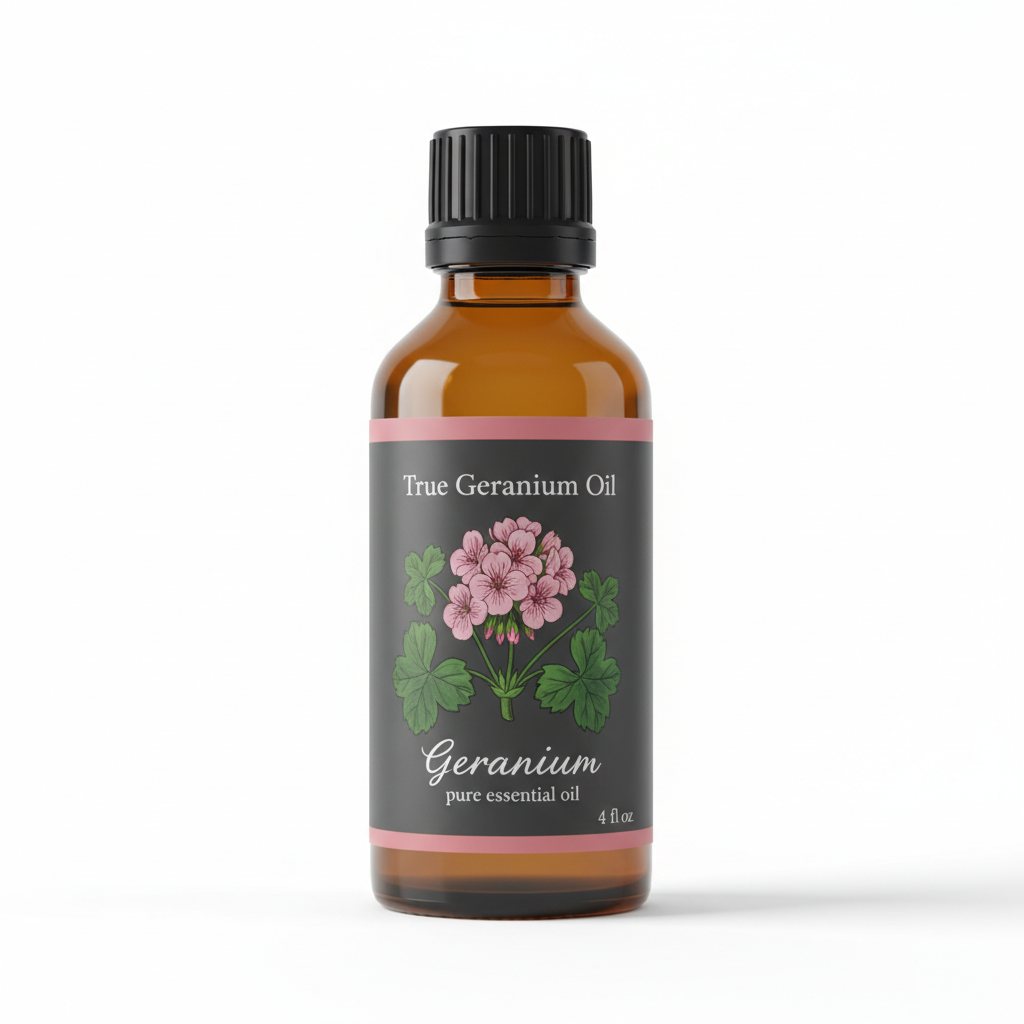
Geranium Essential Oil
Our own Geranium Essential Oil, in sizes from 0.5 oz to bulk.
From $15.99
Shop Now →This deep dive explores the chemistry behind that complexity, what research observations tell us about its key compounds, how sourcing shapes the final aroma, and what you need to know before adding it to your collection.

The Short Answer: What Does Geranium Oil Smell Like?
Geranium essential oil smell is most commonly described as rosy-green with soft citrus undertones and a mild, earthy base. Unlike true rose oil, which is dense and almost velvety, geranium sits lighter on the nose. It has lift. There's a leafy, slightly herbaceous quality underneath the floral top notes, which is why it reads as "green" even while smelling unmistakably rosy.
The oil comes from Pelargonium graveolens and its close relatives, not from the botanical genus Geranium at all. If that distinction is new to you, the complete guide to geranium oil and its botanical identity is a good place to start before going deeper into chemistry.
The scent profile varies noticeably by origin. Bourbon geranium from Réunion Island is widely considered the benchmark: sweeter, more intensely rosy, and distinctly minty in the finish. Egyptian geranium is greener and more herbaceous. Moroccan varieties tend to fall somewhere in between. All three share the same core chemistry, but the ratios shift, and that changes everything about how the oil smells.
Key Aromatic Compounds: What Creates the Scent
Understanding what geranium essential oil smells like requires looking at what's actually inside the bottle. Gas chromatography studies of Pelargonium graveolens oils have consistently identified a handful of compounds that do most of the aromatic heavy lifting.
Citronellol
This monoterpene alcohol typically makes up 20 to 40 percent of the oil, depending on origin and harvest timing. Citronellol is the compound most responsible for the rosy character. It's the same molecule present in rose oil, which explains why geranium is so frequently used as a more affordable stand-in for rose in perfumery and cosmetic formulation. At high concentrations, citronellol smells almost powdery. At the levels found in geranium oil, it stays brighter and fresher.
Geraniol
Geraniol typically appears at 10 to 30 percent concentration. Its scent contribution is sweeter and more floral than citronellol, with a slightly waxy quality that softens the overall profile. Geraniol and citronellol are structural relatives, and together they account for most of what people perceive as the "rosy" dimension of the oil. Research published in fragrance chemistry literature notes that the ratio between these two compounds is one of the primary variables differentiating geranium oils from different growing regions.
Linalool
Present at roughly 5 to 15 percent, linalool contributes a soft, slightly floral and woody smoothness. It's also a major component of lavender oil, which may be why geranium and lavender blend so naturally. Linalool rounds out sharper edges and adds depth without pulling the scent in a dramatically different direction.
Citronellyl Formate
This ester, formed from citronellol and formic acid, adds a fruity and slightly rosy quality with more lift than the alcohols alone. Esters in general tend to be volatile and bright-smelling, and citronellyl formate contributes to the top-note behavior of the oil: that first impression that disappears faster than the base notes.
Isomenthone and Menthone
These ketones, present in smaller amounts (roughly 5 to 10 percent in many samples), account for the minty-herbaceous quality that distinguishes geranium from a straight floral. They're especially prominent in Bourbon geranium. If you've ever noticed a cool, almost peppermint-adjacent freshness in geranium oil, you're detecting these compounds.
10-Epi-gamma-Eudesmol
A sesquiterpene alcohol that contributes earthy, woody depth. It's present in smaller quantities but plays an important role in the dry-down of the oil, the scent that lingers after the lighter volatiles have evaporated.

How the Scent Evolves Over Time
One of the more interesting qualities of geranium essential oil smell is how it behaves across its evaporation curve. Perfumers classify it as a middle note, meaning it doesn't disappear in the first five minutes like a citrus top note, but it also doesn't anchor a blend the way a base note like sandalwood or vetiver does.
On first application, the esters and lighter alcohols hit brightest. The rosy-citrus quality is at its most vivid. Over the next 30 to 60 minutes, the greener, mintier character from the ketones becomes more apparent. By the dry-down, what remains is softer and more earthy, dominated by the sesquiterpene alcohols and the heavier fraction of citronellol.
This evolution is part of why formulators value it. A geranium-forward blend will smell different at application than it does two hours later, which creates complexity without requiring a dozen separate ingredients.
What Research Observations Tell Us About Its Chemistry
Several published studies have profiled Pelargonium graveolens oil using gas chromatography-mass spectrometry (GC-MS), and the findings are useful for understanding quality benchmarks as much as aromatic character.
A 2015 study in the Journal of Essential Oil Research compared geranium oils from different origins and found statistically significant variation in citronellol-to-geraniol ratios between Egyptian, Moroccan, and Réunion Island samples. The authors noted that Bourbon geranium consistently showed higher citronellol content, which aligns with its reputation for a more intensely rosy character.
Research published in Flavour and Fragrance Journal has suggested that the presence and concentration of formate and acetate esters correlates with the fruity brightness that makes some geranium oils smell more vibrant and others more flat. These observations support the practice among experienced buyers of reviewing a GC-MS report before purchasing in bulk.
Some research also suggests that the age and storage conditions of the oil affect its aromatic profile, with oxidation of citronellol over time producing compounds that can introduce off-notes. This is a quality consideration, not simply a theoretical one.
How Production Method Shapes the Aroma

The oil is extracted by steam distillation of the leaves, stems, and flowers of the plant. The distillation conditions, particularly temperature and duration, influence which volatile compounds survive into the final oil. Lower-temperature, shorter distillations tend to preserve more of the lighter esters and produce a brighter, fresher-smelling oil. Longer or hotter distillations can degrade some of those esters and produce a heavier, less nuanced result.
If you want to understand this process more fully, the piece on how geranium oil is made through steam distillation covers the process in detail. What's worth knowing here is that distillation method is one of the variables that explains why two bottles labeled "geranium essential oil" can smell noticeably different from each other.
Quality Indicators: Reading a GC-MS Report
For anyone serious about sourcing, a GC-MS report is the most reliable tool for evaluating geranium oil quality. Here's what to look for:
- Citronellol: Should be between 20 and 40 percent for most geranium varieties. Very low citronellol may indicate adulteration or a poor-quality harvest.
- Geraniol: Typically 10 to 30 percent. High geraniol relative to citronellol suggests a sweeter, more floral character.
- Linalool: 5 to 15 percent is normal. Unusually high linalool can indicate blending with lavender or synthetic linalool addition.
- Citronellyl formate: Presence in reasonable amounts (5 to 10 percent) is a positive quality indicator for bright, complex aroma.
- Isomenthone: Higher concentrations suggest Bourbon origin. Lower concentrations are typical of Egyptian varieties.
Adulteration of geranium oil is common, particularly with synthetic citronellol, geraniol, or blending with cheaper carrier materials. A reputable supplier will provide a batch-specific GC-MS report and ideally offer samples before bulk purchase.
Safety Profile and Contraindications
Geranium oil has a well-documented safety profile, though several considerations are worth knowing before use.
Skin Sensitization
The Research Institute for Fragrance Materials (RIFM) classifies geraniol and citronellol as potential skin sensitizers at elevated concentrations. The International Fragrance Association (IFRA) sets usage limits for these compounds in leave-on and rinse-off products. For leave-on skin applications, geranium oil is generally diluted to 1 to 2 percent in a carrier oil. Undiluted application directly to skin is not recommended.
If you're new to working with geranium oil, the guide on dilution ratios, carrier oils, and first steps with geranium oil covers safe application practices in full.
Patch Testing
Before using any diluted preparation on a larger area of skin, a patch test is recommended. Apply a small amount of the diluted blend to the inner forearm, wait 24 hours, and check for redness, itching, or irritation before proceeding.
Pregnancy and Nursing
Some sources advise caution with geranium oil during pregnancy, particularly in the first trimester, due to its hormonal activity potential as suggested by some preliminary research. Consult a qualified healthcare provider before use during pregnancy or while nursing.
Children
Essential oils should be used with additional caution around young children. Lower dilution ratios (0.5 percent or less) are typically recommended for children over two, and use is generally not advised for infants. A pediatrician or qualified aromatherapy practitioner can provide guidance specific to your situation.
Oxidation
As noted above, geranium oil can oxidize over time, particularly if stored in warm temperatures or with inconsistent cap closure. Oxidized oil carries a higher sensitization risk. Store oil in a dark, cool location, keep caps tight, and aim to use the oil within 2 years of opening.
Blending with Geranium: What Pairs Well and Why
The rosy-green character of geranium makes it genuinely versatile in blending. Because it carries both floral and herbaceous registers, it bridges notes that might otherwise feel disconnected.
| Companion Oil | What the Pairing Achieves |
|---|---|
| Lavender | Softens the green edge; adds a calming, rounded quality |
| Rose absolute | Deepens the rosy dimension; geranium extends the character at lower cost |
| Bergamot | Brightens the citrus note; adds freshness to the opening |
| Cedarwood | Provides a woody, anchoring base that balances the light florals |
| Clary sage | Adds an earthy, slightly musky dimension; blends smoothly with the herbaceous notes |
| Patchouli | Heavy base note that grounds the blend; contrasts well with the bright top notes |
The shared chemistry between geranium and rose (specifically citronellol and geraniol) makes geranium a natural partner for any rose-family fragrance. Perfumers frequently use geranium as both an extender and a brightener in rose-forward compositions.
A Note on Common Confusion
Some buyers, after purchasing geranium oil for the first time, report being surprised that it smells more green and less purely floral than expected. This is usually not a quality defect. It's the natural character of the oil. The green quality comes from the menthone and isomenthone content, and it's more pronounced in Egyptian and Moroccan varieties than in Bourbon geranium.
If you want the most intensely rosy version of what geranium oil can smell like, seek out a certified Bourbon geranium from Réunion Island and verify the GC-MS report shows citronellol in the upper range (35 percent or above). That's the closest the plant gets to a true rose character without crossing into rose absolute territory.
The complexity is part of the appeal. Geranium oil rewards attention. The more you work with it across different origins and in different blending contexts, the more dimensions of the scent become apparent. It's a genuinely interesting oil to know well.