
Is Geranium Oil Phototoxic? What the Reference Books Actually Say
Few questions come up more consistently in geranium oil discussions than this one: can it make your skin more sensitive to sunlight? It is a fair concern, especially given how freely people reach for geranium in facial blends, body oils, and sun-adjacent summer routines. The short answer is reassuring, but the long answer is worth reading. Below, we have pulled together the most common questions on this topic and answered each one directly, drawing on what the major reference books actually say.
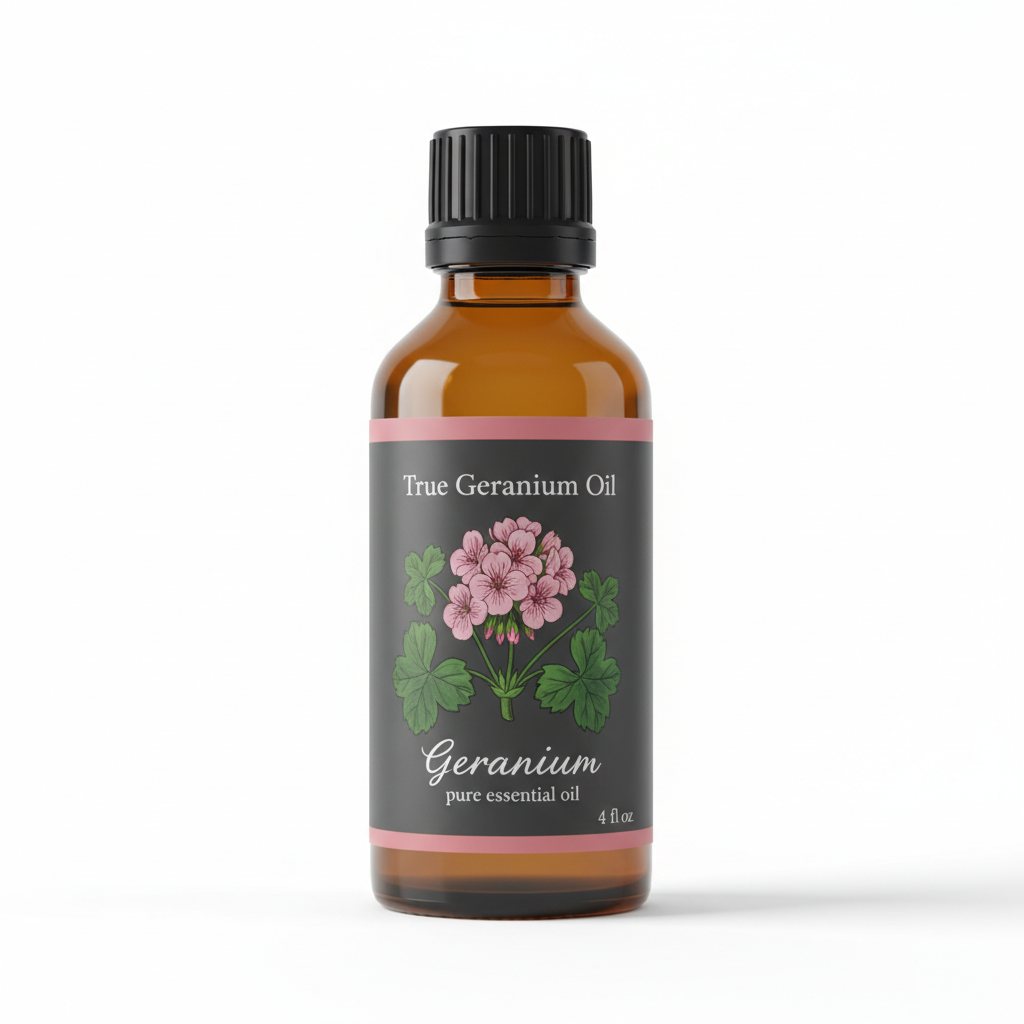
Geranium Essential Oil
Our own Geranium Essential Oil, in sizes from 0.5 oz to bulk.
From $15.99
Shop Now →For a broader foundation on the oil itself, start with our guide on what geranium oil is and where it comes from. Then come back here for the photosafety specifics.
The Basics: Phototoxicity and Essential Oils
Q1. What does phototoxicity actually mean in the context of essential oils?
Phototoxicity (sometimes called photoirritation) refers to a reaction that can occur when certain compounds in an oil absorb UV radiation after being applied to skin, producing a response ranging from redness and darkening to more pronounced irritation. The compounds most commonly responsible are furocoumarins, particularly psoralens and bergaptens. Not every essential oil contains these compounds, which is why phototoxicity is not a blanket concern for all oils.
Q2. Which types of oils are most commonly associated with phototoxicity?
Cold-pressed citrus oils are the classic examples: bergamot, lime, lemon, and grapefruit appear most frequently in phototoxicity discussions in the reference literature. Certain other botanicals, including angelica root and fig leaf absolute, also carry furocoumarin content that warrants caution. Geranium does not belong to this citrus or apiaceae family group, which is part of why its profile looks different.
Q3. Are all essential oils assumed phototoxic until proven otherwise?
No. In Robert Tisserand and Rodney Young's Essential Oil Safety (2nd edition), oils are evaluated individually for their constituent profiles, and phototoxicity is only flagged when relevant compounds are identified. Assuming all essential oils carry phototoxic risk would be inaccurate and would make formulation unnecessarily complicated for the many oils that simply do not contain furocoumarins.
What Tisserand Says About Geranium Oil
Q4. Does Tisserand classify geranium essential oil as phototoxic?
No. In Essential Oil Safety, geranium essential oil phototoxicity is not listed as a concern. Tisserand and Young do not place geranium (Pelargonium graveolens or Pelargonium x asperum) in the phototoxic category, and no maximum usage level related to UV exposure is specified for it. This is a notable and reassuring distinction from the cold-pressed citrus oils, which receive explicit phototoxicity warnings in the same text.
Q5. Does Tisserand identify any other cautions for geranium oil on skin?
Yes, and it is worth knowing these even if phototoxicity is not among them. Tisserand notes potential for skin sensitization in some individuals, particularly at higher concentrations, and recommends adhering to dilution guidelines. The suggested maximum dermal use level in Essential Oil Safety for geranium (Bourbon type) is 17.5%, though most everyday cosmetic blends use far less than this. Patch testing is always a sensible step before applying any new oil blend to a large skin area.
Q6. Why do people specifically search for "geranium essential oil phototoxic Tisserand"?
Because Tisserand and Young's Essential Oil Safety is widely regarded as the most authoritative safety reference in the field, both by professional aromatherapists and by cosmetic formulators. When someone wants to confirm whether an oil is safe to use before sun exposure, citing Tisserand is the most rigorous way to do that. Searching for the Tisserand assessment of geranium phototoxicity is simply good research practice.
Q7. What edition of Essential Oil Safety should I be referencing?
The second edition (2014) is the current standard reference. The first edition is significantly outdated in its constituent data and safety classifications. If you see older internet posts quoting Tisserand on geranium, it is worth checking whether the source is using the updated 2nd edition, since formulation guidance has evolved considerably between printings.
Other Reference Books on Geranium Phototoxicity

Q8. What does Salvatore Battaglia's The Complete Guide to Aromatherapy say?
Battaglia's third edition also does not list geranium as a phototoxic oil. His safety notes for geranium center on possible sensitization with repeated high-concentration use, and he notes that the oil is generally well-tolerated in standard cosmetic dilutions. This aligns closely with the Tisserand assessment, which is reassuring when two independent reference authors reach the same conclusion.
Q9. Does the IFRA (International Fragrance Association) flag geranium as phototoxic?
IFRA standards set usage limits for fragrance ingredients based on safety data, and geranium does not appear in IFRA's list of restricted or prohibited ingredients due to phototoxicity. IFRA does address certain Pelargonium-derived materials in relation to sensitization potential, which is a separate concern from phototoxicity. Formulators working under IFRA compliance guidelines should always consult the current published standards directly, as these are updated periodically.
Q10. Are there any published studies suggesting geranium oil is phototoxic?
No peer-reviewed studies specifically identifying geranium essential oil as phototoxic have been highlighted in the major reference literature. Some research has examined individual constituents such as citronellol and geraniol (key components of geranium oil) without identifying furocoumarin activity. You can explore the chemistry of these compounds in more depth in our article on the rosy chemistry of geranium oil.
Practical Use: Geranium Oil Before Sun Exposure
Q11. Is it safe to use geranium oil in a body lotion I plan to wear outdoors?
Based on current reference literature, geranium essential oil does not carry a phototoxic designation, so it is not flagged as requiring avoidance before sun exposure the way bergamot or cold-pressed lime would be. That said, proper dilution is still important for skin comfort generally. A typical safe cosmetic dilution for leave-on body products is 0.5% to 2%, and staying within that range is good practice regardless of UV concerns.
Q12. What about geranium in a facial oil or serum used during the day?
Geranium's absence from the phototoxicity list means it does not need to be reserved for nighttime use on photosafety grounds. For daytime facial use, the standard guidance applies: dilute appropriately (typically 0.5% to 1% for facial products), patch test before broad application, and follow with a broad-spectrum SPF as part of your regular routine. The SPF advice applies universally, not specifically because of geranium.
Q13. Can I blend geranium with a phototoxic oil and still go in the sun?
This depends entirely on the phototoxic oil in the blend, not on the geranium. If your formula includes cold-pressed bergamot, cold-pressed lime, or another furocoumarin-containing oil, those ingredients set the UV exposure rules for the entire product. Geranium does not neutralize or reduce the phototoxic potential of other oils, so standard avoidance guidance for the phototoxic component still applies.
Q14. Does steam-distilled versus solvent-extracted geranium oil make any difference for phototoxicity?
For citrus oils, extraction method matters enormously: steam-distilled versions of bergamot or lime lose their furocoumarins during the heat process, which is why bergaptene-free bergamot is phototoxicity-free. For geranium, this distinction is less practically significant because the oil is not phototoxic in either form. Most commercial geranium essential oil is steam-distilled, and the reference literature does not flag the steam-distilled version as a concern.
Sourcing, Variety, and Quality Considerations

Q15. Does the variety of geranium (Bourbon vs. Egyptian vs. Chinese) affect phototoxicity risk?
None of the major geranium varieties commonly distilled for commercial essential oil (Reunion/Bourbon, Egyptian, Chinese) are identified as phototoxic in the reference literature. Their constituent profiles differ in ratios of citronellol, geraniol, linalool, and other compounds, but furocoumarins are not a defining characteristic of any of them. For a closer look at how the chemistry varies by origin, our article on citronellol and geraniol in geranium oil breaks this down further.
Q16. Could adulteration or poor-quality geranium oil introduce phototoxic compounds?
Theoretically, if an oil labeled as geranium were adulterated with a citrus material or an unrelated botanical containing furocoumarins, that could change its safety profile. This is one of several reasons why sourcing from suppliers who provide GC/MS (gas chromatography/mass spectrometry) batch reports matters. Verified composition data lets you see what is actually in the bottle, rather than relying on label claims alone.
Q17. Is rose geranium different from regular geranium for phototoxicity purposes?
"Rose geranium" typically refers to Pelargonium graveolens or closely related cultivars selected for their stronger rose-like scent profile, and it is not a botanically separate species with a distinct phototoxicity classification. The reference literature does not differentiate between rose geranium and standard geranium on phototoxicity grounds. Both are drawn from the same Pelargonium genus and carry the same general safety notes.
Dilution, Patch Testing, and Formulation Safety
Q18. Even without phototoxicity concerns, what dilution should I use for geranium in a leave-on product?
For most leave-on skin applications, a dilution of 0.5% to 2% in a suitable carrier is widely cited as an appropriate cosmetic range. The National Association for Holistic Aromatherapy (NAHA) and Tisserand's guidelines both suggest that facial applications benefit from staying at the lower end of that range. For body products, up to 2% is generally considered comfortable for most adults, though individual skin sensitivity varies.
Q19. How do I properly patch test a geranium oil blend?
Apply a small amount of the diluted blend (never undiluted essential oil) to the inner forearm or behind the ear, cover lightly, and leave for 24 hours. Check for redness, itching, or any change in skin appearance at the test site before applying the blend more broadly. If any reaction occurs, discontinue use and consult a qualified skincare professional or dermatologist before proceeding.
Q20. Are there any populations who should be more cautious with geranium oil, regardless of phototoxicity?
Pregnant individuals, young children, and people with known sensitivities to botanicals in the Geraniaceae family should approach geranium oil with extra care and seek guidance from a qualified healthcare provider before use. Pet owners should also be aware that essential oils may pose risks to companion animals. Our dedicated guide on geranium oil safety for dogs and cats covers this topic specifically.
Q21. Should I still avoid sun exposure after using a geranium-based product, just to be safe?
The reference literature does not require this specifically for geranium. However, broad-spectrum SPF use is a sound daily habit regardless of what you apply to your skin, and it pairs well with any botanical skincare routine. Wearing SPF is not a reflection of geranium's safety profile; it is simply good general skin practice.
Common Misconceptions

Q22. I read online that geranium oil causes sun sensitivity. Is that accurate?
This appears to be a persistent misconception, possibly from conflating geranium with citrus oils or from broadly applying phototoxicity warnings across all essential oils as a precaution. Neither Tisserand and Young's Essential Oil Safety nor Battaglia's Complete Guide to Aromatherapy supports this claim. When in doubt, checking a specific oil against a named, reputable reference is more reliable than general online posts.
Q23. Does the rose-like scent of geranium mean it has anything in common with bergamot, which is phototoxic?
No. Scent profile and botanical family are entirely separate considerations. Bergamot (Citrus bergamia) is a citrus fruit; geranium (Pelargonium graveolens) is a leafy perennial plant from a completely different family. They share certain aromatic compounds such as linalool, which contributes a floral quality to both, but the furocoumarin content that makes bergamot phototoxic is not present in geranium.
Q24. Is it true that any oil high in linalool is phototoxic?
No. Linalool is a widely distributed terpene alcohol found in lavender, geranium, coriander, and many other oils, and it is not a furocoumarin. Its presence does not confer phototoxicity. The phototoxicity of an oil is determined by its furocoumarin content, which is a structurally distinct category of compound from terpene alcohols like linalool.
Q25. If geranium oil is not phototoxic, why do some products label it with UV warnings?
Some manufacturers apply blanket UV caution labels to all products containing essential oils as a broad precautionary measure, regardless of whether a specific oil is phototoxic. This is a conservative formulation policy rather than a reflection of geranium's individual safety data. It is worth distinguishing between a general disclosure applied across a product line and a specific, evidence-based phototoxicity flag for a named botanical ingredient.
A Quick Reference Summary
| Reference Source | Phototoxic Classification for Geranium? | Key Safety Notes |
|---|---|---|
| Tisserand & Young, Essential Oil Safety (2nd ed.) | No | Possible sensitization at high concentrations; maximum dermal level cited |
| Battaglia, Complete Guide to Aromatherapy (3rd ed.) | No | Well-tolerated at standard cosmetic dilutions; sensitization possible with prolonged high-dose use |
| IFRA Standards | No phototoxicity restriction | Sensitization limits apply; consult current published standards |
A note on using this information: This FAQ is for educational and cosmetic formulation purposes only. Always consult a qualified healthcare provider before incorporating any essential oil into your personal routine, particularly if you have existing skin sensitivities, are pregnant, or are using any topical product alongside prescription skincare.