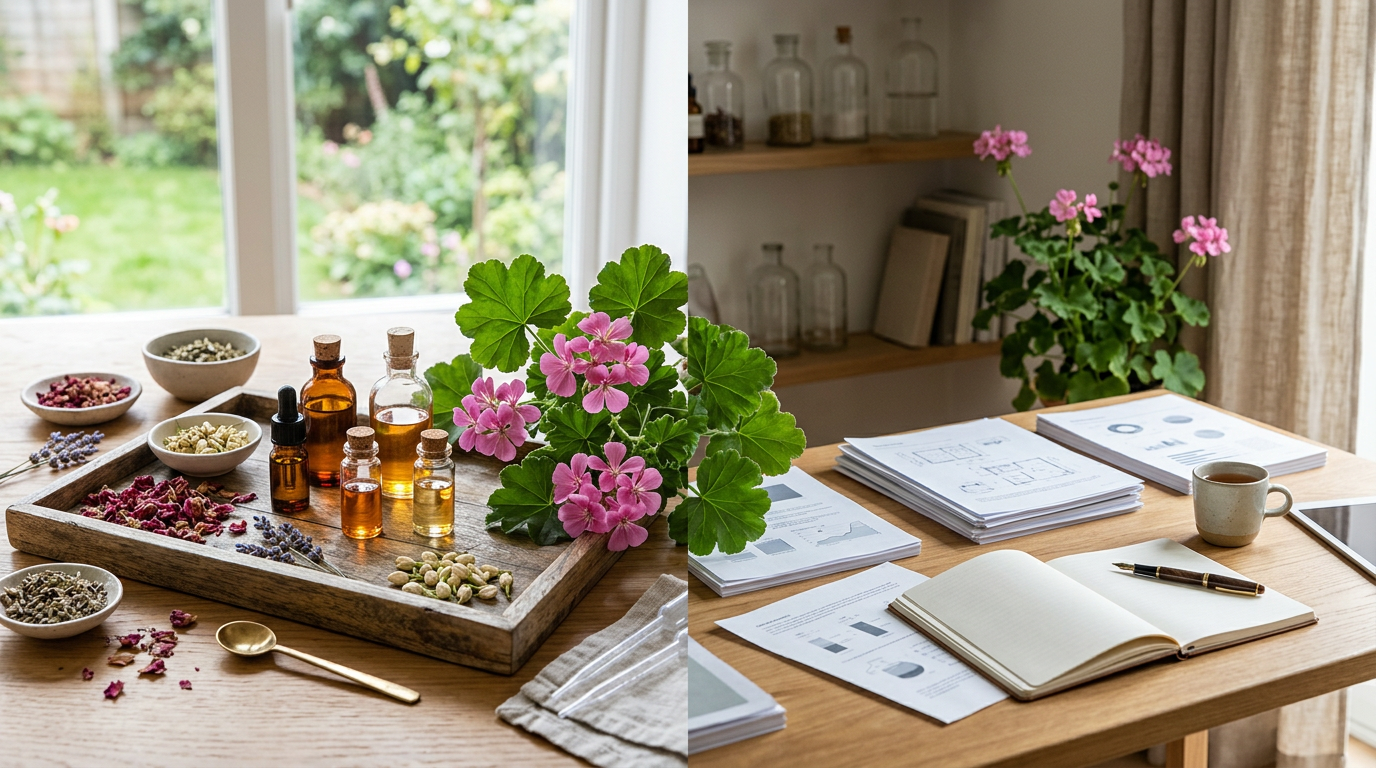
The Rose Garden Blend: Our Signature Geranium, Palmarosa, and Bergamot Mix
Some blends come together through careful calculation. Others arrive almost by accident, when you reach for three bottles that happen to be sitting together on the shelf and suddenly the room smells like a late-June garden after rain. This geranium blend recipe belongs to the second category. It started as an experiment and became a fixture in our studio.
Geranium Essential Oil
Our own Geranium Essential Oil, in sizes from 0.5 oz to bulk.
From $15.99
Shop Now →The core trio here is geranium, palmarosa, and bergamot. Each one carries a distinct floral-green character, and when they meet in the right proportions, the result is something we call the Rose Garden Blend: a signature floral blend that reads as lush and a little romantic without tipping into sweetness. We add a fourth note, Boswellia serrata, for reasons we will explain in detail below. It is quiet in the formula, but you would notice immediately if it were missing.
This guide covers everything: the rationale behind each ingredient, precise measurements in both drops and milliliters, step-by-step blending instructions, safe dilution ratios, storage guidance, and three variations to try once you have the original down.
Why These Four Ingredients
True Geranium Oil: The Heart Note
True geranium oil (Pelargonium graveolens and its close relatives) is the anchor of any rose garden essential oil blend worth making. Its aroma profile is complex in a way that surprises first-time users: rosy, yes, but also green and slightly minty, with a waxy depth underneath. It does not smell like a single cut rose. It smells like standing among rose bushes, leaves and all.
For a deeper look at what makes geranium oil such a versatile starting point, see our complete guide to geranium oil uses for skin and home.
Palmarosa: The Quiet Amplifier
Palmarosa (Cymbopogon martinii) is a tropical grass that produces an oil rich in geraniol, the same compound responsible for much of geranium's rosy character. The two oils are not identical, but they are genuinely compatible. Palmarosa adds a softer, slightly sweeter floral note that rounds the geranium's sharper green edges. It also extends the longevity of the blend on skin and fabric, functioning as a natural fixative without adding heaviness.
Bergamot: The Light and the Lift
Cold-pressed bergamot from the rind of Citrus bergamia brings citrus brightness that keeps this blend from feeling too dense or serious. The top note evaporates quickly, as all citrus does, but while it is present it creates an opening impression that feels sunlit. Use a furanocoumarin-free (FCF) bergamot if you plan to use this blend in a leave-on application. Standard bergamot contains furanocoumarins that increase photosensitivity.
Boswellia serrata: The Base That Holds Everything Together
This is where the blend earns its depth. Boswellia serrata, sourced primarily from India, produces a resinous, woody, slightly spicy oil that is notably softer in character than some of its East African relatives. Where Boswellia carterii can read as sharp and camphoraceous, serrata tends toward a warmer, almost balsamic drydown. That warmth is exactly what a floral blend needs at its base: something that keeps the top and heart notes from floating away.
Serrata also has a practical advantage. Its aroma is less dominant than sacra or frereana, which means it does not compete with the florals. It supports. In our Rose Garden Blend, it functions less as a recognizable frankincense note and more as a sensation of groundedness that you feel before you can name it.
The Signature Rose Garden Blend: Full Recipe
What You Will Need
- A clean 5 ml or 10 ml amber glass roller bottle or dropper bottle
- A calibrated pipette or glass dropper (optional but helpful for accuracy)
- A fine-point marker for labeling
- A carrier oil of your choice for dilution (see ratios below)
- A small notebook to record any adjustments you make
Ingredients and Measurements
| Ingredient | Drops (concentrate) | Approximate ml (concentrate) | Role |
|---|---|---|---|
| True geranium oil | 10 drops | 0.50 ml | Heart note, rosy-green anchor |
| Palmarosa | 8 drops | 0.40 ml | Soft floral amplifier, fixative |
| Bergamot FCF | 6 drops | 0.30 ml | Citrus top note, brightness |
| Boswellia serrata | 4 drops | 0.20 ml | Resinous base, depth |
This recipe makes a concentrate of approximately 28 drops (1.40 ml). Store the concentrate neat and dilute at the time of use, or blend directly into your chosen carrier for a ready-to-use product.
Step-by-Step Blending Instructions
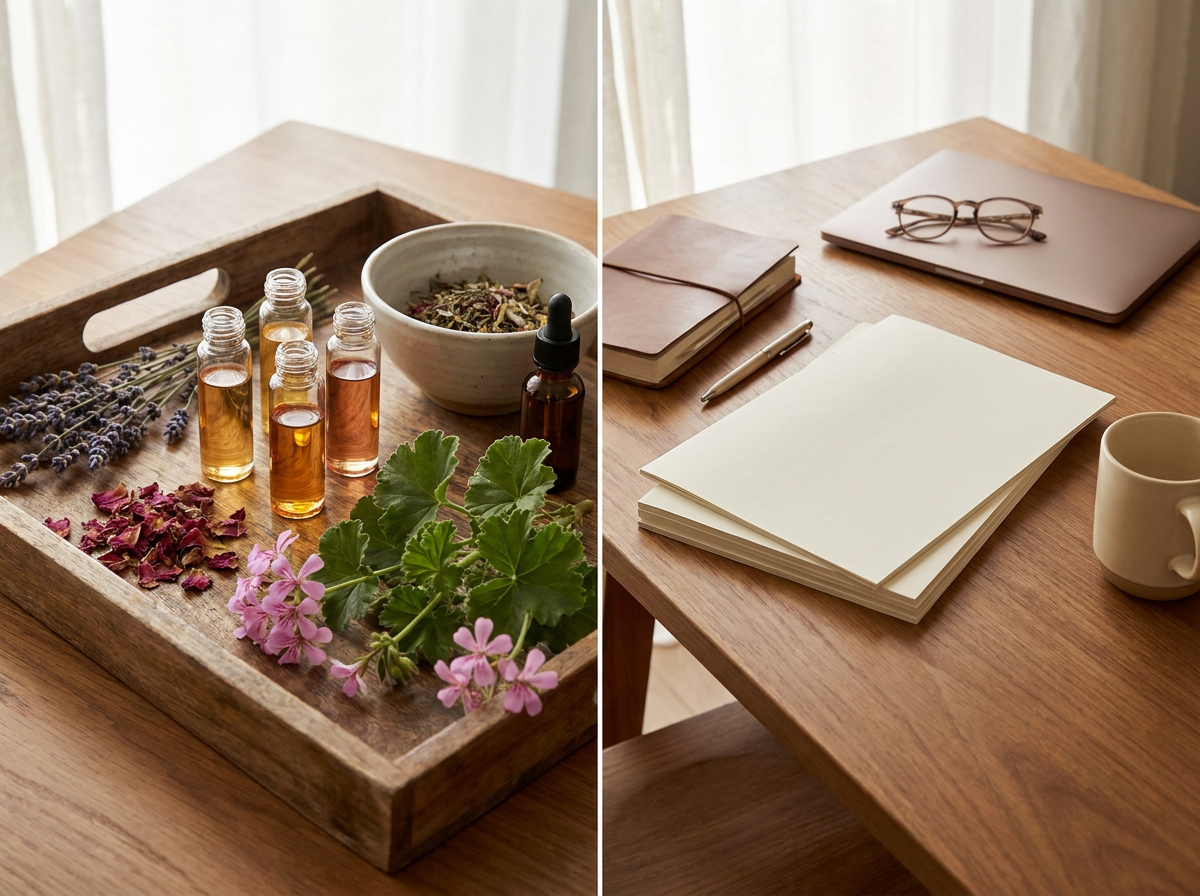
- Prepare your workspace. Work on a clean, hard surface away from direct sunlight. Have all bottles within reach before you open anything. Essential oils begin to interact with surrounding air from the moment the cap comes off.
- Add the base note first. Drop your 4 drops of Boswellia serrata into the empty bottle. Starting with the heaviest, slowest-evaporating note gives you a stable foundation and makes it easier to gauge how the lighter notes are building.
- Add the heart note. Drop in 10 drops of geranium oil. Cap the bottle briefly and swirl gently. You are not shaking yet. You are just beginning to let the molecules meet.
- Add palmarosa. Drop in 8 drops. Swirl again. At this stage the blend will already smell recognizably floral and rosy with a resinous undertone.
- Add bergamot last. The top note goes in last so you can control how bright the opening impression is. Add 6 drops, cap the bottle, and swirl for 20 to 30 seconds.
- Rest the blend. Set the capped bottle aside for at least 24 hours. This resting period, sometimes called maceration in perfumery, allows the molecules to integrate. The blend you smell on day two will be noticeably smoother than day one.
- Evaluate and adjust. After resting, open and smell on a paper strip or the back of your wrist (diluted). If the bergamot feels too dominant, add 2 more drops of geranium. If the base feels too soft, add 1 to 2 more drops of serrata. Record every adjustment.
- Dilute before use. See the dilution section below before applying to skin.
Dilution Ratios and Safe Use
Essential oils must always be diluted in a carrier oil before skin contact. Using them neat (undiluted) significantly increases the risk of irritation or sensitization.
- For most adults, general body use: 2% dilution. Add approximately 12 drops of concentrate per 30 ml (1 oz) of carrier oil.
- For facial skin: 1% dilution. Add approximately 6 drops of concentrate per 30 ml of carrier oil. Geranium and palmarosa are both well-regarded in skin care, but facial skin is more reactive.
- For diffusion: No dilution needed. Use 6 to 8 drops of concentrate total in a standard ultrasonic diffuser for a 200 to 300 ml water capacity.
- For a room or linen mist: Add 15 to 20 drops of concentrate to 100 ml of distilled water and 10 ml of high-proof alcohol (such as perfumer's alcohol) to help disperse. Shake before each use.
Patch Testing
Before using any new blend on a larger area of skin, always perform a patch test. Apply one small drop of the diluted blend to the inside of your elbow or wrist. Wait 24 hours and check for redness, itching, or any other response before proceeding with wider use.
Important Safety Notes
- If you use standard (non-FCF) bergamot, avoid direct sunlight or UV exposure on any skin where the diluted blend has been applied for at least 12 hours.
- Keep all essential oils away from eyes and mucous membranes.
- Keep bottles out of reach of children and pets.
- If you are pregnant, nursing, or managing any health situation, consult a qualified healthcare provider before using essential oil blends.
- This blend is formulated for aromatic and cosmetic enjoyment only.
Storage and Shelf Life
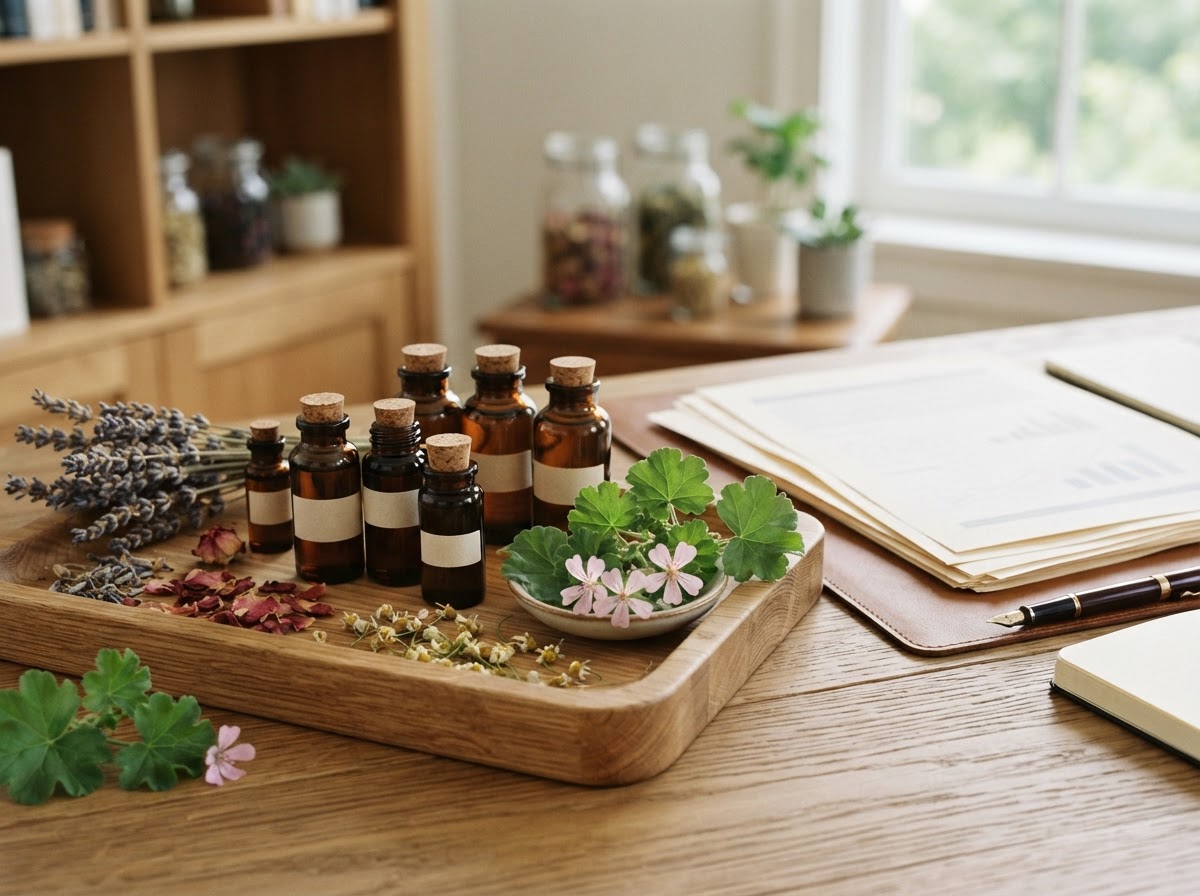
Store your concentrate in a dark amber or cobalt glass bottle with a tight-fitting cap. Keep it in a cool, dark location, away from heat sources and direct light. A drawer or a small dedicated essential oil case works well.
Properly stored, your concentrate should remain stable for 12 to 18 months. Bergamot is the most volatile component and will shift first. If the top note begins to smell flat or slightly off, the blend is past its best aromatic window. Palmarosa and serrata have longer stability, so the base and heart will likely remain pleasant even after the bergamot has faded. Once diluted in a carrier oil, use within 6 to 9 months and store in the refrigerator if possible to extend stability.
Variations to Try
Variation 1: The Dewy Morning Version
Replace the bergamot with an equal quantity of lemon verbena or petitgrain bigarade. The result is greener and crisper, closer to a garden at 7 a.m. than at noon. Use FCF-processed options for any leave-on application, as petitgrain bigarade is generally considered non-phototoxic but verify your specific source's safety data.
Variation 2: The Evening Garden Version
Reduce the bergamot to 3 drops and add 3 drops of ylang ylang complete in its place. Ylang ylang deepens the floral character significantly and adds a narcotic richness that suits a quiet evening wind-down ritual. If you enjoy exploring geranium in that context, our article on geranium and quiet evenings goes into more detail on building a calming scent ritual around this oil.
Variation 3: The Grounded Green Version
Add 3 drops of vetiver to the original formula and increase the serrata to 6 drops. This variation leans earthier and more complex. The rosy florals still come through, but they are wrapped in something more rooted and quiet. It works beautifully in a diffuser on a cool evening and holds up particularly well as a personal fragrance diluted in jojoba at 2%.
A Note on Sourcing
The quality of a blend depends entirely on the quality of its components. With a rose garden essential oil blend like this one, where the florals are doing most of the expressive work, there is very little room for a weak or adulterated geranium or palmarosa to hide. Buy from suppliers who provide batch-specific GC/MS testing reports and can tell you where the plant material was grown and how it was distilled.
Geranium is frequently adulterated with synthetic geraniol or blended with cheaper citronella fractions. Palmarosa is more reliably pure in the commercial supply, but quality still varies considerably between distillation regions. For Boswellia serrata specifically, look for a supplier who sources directly from India and provides documentation of the resin origin.
Curious about some of the outdoor claims that circulate around rose geranium oil online? Our article on rose geranium oil and outdoor claims takes an honest look at what the evidence actually shows, and what it does not.
Making It Your Own
The proportions in this signature floral blend are a starting point, not a fixed formula. Perfumery works by ratio, not by rigid rule. Once you have made the original version at least twice, begin experimenting with single-drop adjustments and record every change. Some people find they prefer geranium at 12 drops for a more dominant rosy character. Others pull the serrata up to 6 drops for a stronger resinous base.
The blend rewards attention. Give it time to rest between each evaluation. Trust your nose over any chart or formula. And keep the resting period sacred: opening a just-made blend and deciding it needs more of something is nearly always a mistake you will correct after 24 hours of integration.
This is one of the quieter pleasures of working with essential oils. The components exist, the ratios exist, the instructions exist. The garden, though, is yours to grow.