
Geranium Oil vs Fragrance Oil: What the Label Hides
Pick up two bottles at a market stall. Both say "geranium" on the front. Both smell pink and rosy and convincing. The prices, though, are worlds apart. If you've ever wondered why, you're asking exactly the right question. The label on a bottle of geranium fragrance oil is not lying, exactly. It's just not telling the whole story.
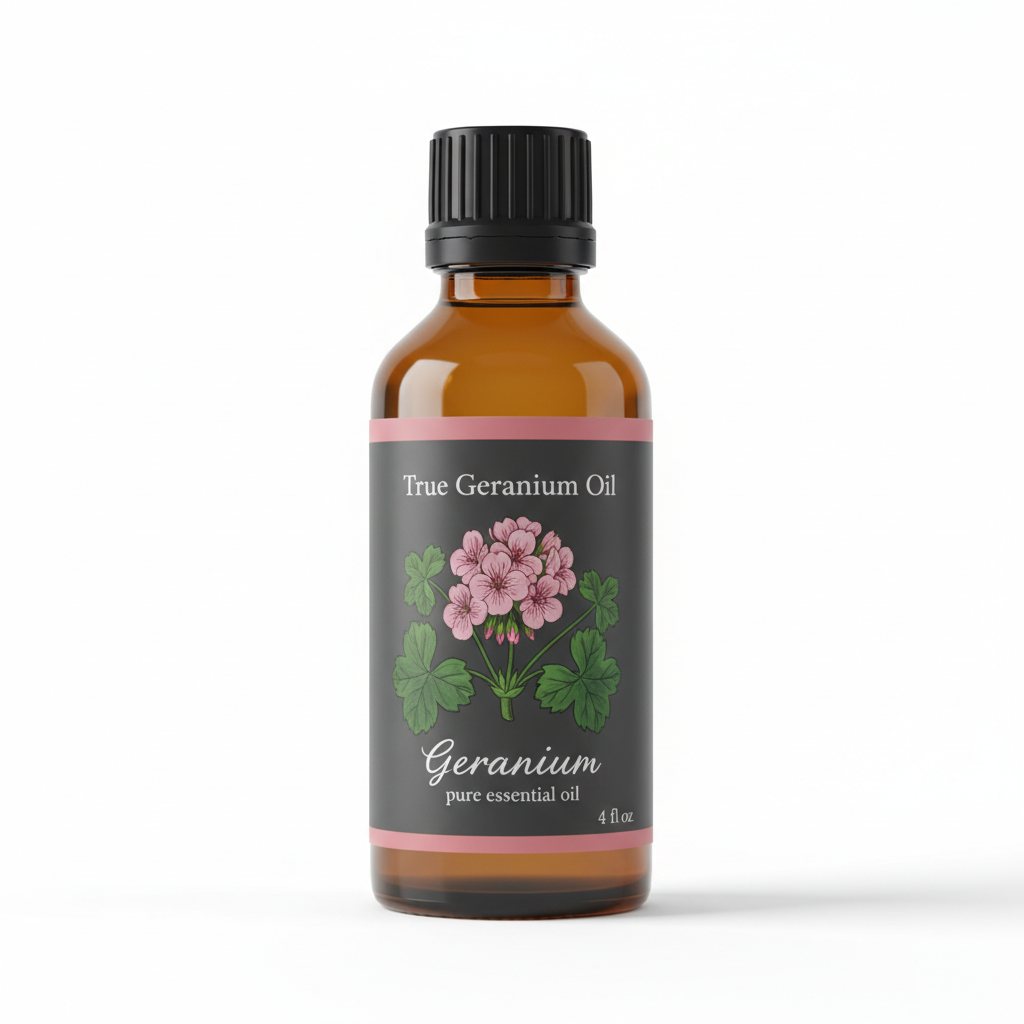
Geranium Essential Oil
Our own Geranium Essential Oil, in sizes from 0.5 oz to bulk.
From $15.99
Shop Now →This article works through the most persistent myths surrounding geranium oil vs fragrance oil, explains the evidence behind each one, and gives you the vocabulary to read a label before you buy.
A Quick Framing Note Before the Myths
True geranium oil (sometimes called rose geranium oil) is steam-distilled from the leaves and stems of Pelargonium graveolens and its close relatives, primarily grown in Egypt, South Africa, and the island of Réunion. Its scent profile is complex: rosy, green, slightly minty, and earthy all at once.
A geranium fragrance oil is a synthetic or blended aromatic compound engineered to smell like geranium. It may contain some plant-derived material, or none at all. Both are legitimate product categories with genuine uses. The problem starts when marketing blurs the line between them.
Myth 1: "If It Smells Like Geranium, It Is Geranium Oil"
The Myth
A rosy, slightly green floral scent in a bottle is geranium essential oil.
The Truth
Fragrance chemists are extraordinarily skilled at replicating natural scent profiles. A well-formulated geranium fragrance oil can smell nearly indistinguishable from the real thing to an untrained nose. Evidence from fragrance industry literature indicates that synthetic linalool, citronellol, and geraniol, the primary aromatic compounds in Pelargonium graveolens, can be produced in a laboratory and blended to mimic the natural oil closely.
The nose alone is not a reliable instrument for this comparison. Smell is a starting point, not a conclusion.
Why the Myth Exists
Geranium has a strong, distinctive scent that most people associate instantly with the plant. When a product smells right, the brain fills in the rest. Marketers know this, which is why front labels often lead with evocative imagery of flowers and gardens rather than ingredient lists.
The fix is simple: flip the bottle. Look for the INCI (International Nomenclature of Cosmetic Ingredients) name. True geranium essential oil will list Pelargonium graveolens oil or Pelargonium x asperum oil. A fragrance oil will often list "fragrance" or "parfum" as a single ingredient, which is a legal catch-all for any blend of aromatic compounds. For a deeper breakdown of how to read these labels before you shop, see our complete guide to buying geranium oil types.
Myth 2: "Fragrance Oils Are Just Cheap Knock-Offs"

The Myth
Geranium fragrance oils are inferior, low-quality imitations that no serious buyer should consider.
The Truth
This one deserves to be pushed back on firmly. Fragrance oils serve real, legitimate purposes. In candle-making, soap production, and many rinse-off cosmetics, fragrance oils are often the preferred choice because they hold scent more consistently through the manufacturing process. They are also more affordable, which matters for product lines aimed at everyday indulgence rather than premium aromatics.
A luxury bath product like a Floris rose geranium bath oil, for instance, may use a combination of natural and synthetic aromatic compounds to achieve a consistent scent signature across batches. This is standard practice in fine fragrance and high-end cosmetics. The goal there is olfactory artistry and a reliable sensory experience, not botanical purity. Neither objective is wrong. They are simply different.
The myth of the "cheap knock-off" flattens a spectrum. Some fragrance oils are indeed low-grade products using the cheapest available synthetics and carrier bases. Others are sophisticated compositions from respected fragrance houses. Price point and intended use matter enormously when evaluating quality.
Why the Myth Exists
The essential oil community, understandably passionate about botanical integrity, sometimes frames the conversation as a binary: natural equals good, synthetic equals bad. Research suggests the picture is more nuanced than that. What matters is fitness for purpose. A fragrance oil used in a scented candle is doing exactly what it is designed to do. It becomes a problem only when it is misrepresented as something it is not.
Myth 3: "All Geranium Essential Oils Are the Same"
The Myth
Once you've confirmed a bottle contains genuine Pelargonium graveolens essential oil, the quality question is settled.
The Truth
Significant variation exists within the category of genuine geranium essential oil. Growing region, harvest timing, distillation method, and post-distillation handling all influence the final chemical composition and scent character.
Egyptian geranium oil tends toward a softer, more rosy profile. Bourbon geranium oil from Réunion is often regarded as more refined, with a pronounced floral top note that perfumers prize highly. South African varieties can read as greener and more herbaceous. These are not interchangeable, and a label that simply says "geranium essential oil" without specifying origin tells you relatively little about what's inside.
GC/MS (gas chromatography/mass spectrometry) testing is the industry standard for verifying the chemical composition of an essential oil batch. Reputable suppliers publish these reports or make them available on request. Evidence indicates that oils sold without any batch-specific documentation carry a higher risk of adulteration, dilution, or mislabeling. For a side-by-side look at how major brands handle sourcing and transparency, our geranium oil brand comparison covers the specifics.
Why the Myth Exists
Essential oil marketing tends to present purity as the single decisive criterion. If it's pure, the thinking goes, it's good. Purity matters, but it is the floor, not the ceiling. Origin, chemotype, and post-harvest handling shape quality just as meaningfully.
Myth 4: "Natural Always Means Safer for Skin"

The Myth
Because true geranium essential oil is plant-derived, it is automatically gentler and safer for skin than a fragrance oil.
The Truth
Natural origin does not equal skin safety. Both true geranium essential oil and geranium fragrance oil require careful handling when used on skin.
Geranium essential oil contains naturally occurring compounds (citronellol, geraniol, linalool) that the Research Institute for Fragrance Materials (RIFM) has identified as potential sensitizers in some individuals. Evidence from cosmetic safety literature indicates that these compounds, whether derived from plant distillation or synthesized in a laboratory, carry comparable sensitization profiles at equivalent concentrations.
For any leave-on skin application, essential oils generally require dilution to a 1-2% concentration in a suitable carrier oil. Rinse-off products allow slightly higher percentages, but professional cosmetic formulation guidance should be followed. A patch test on a small area of inner arm skin, observed for 24 hours before broader use, is a sensible precaution with any new aromatic product.
The "natural equals safe" shorthand is one of the most consequential myths in the aromatics space. Consult a qualified healthcare provider or certified cosmetic formulator with any specific skin concerns.
Why the Myth Exists
"Natural" has become a powerful marketing signal, and the word is largely unregulated in cosmetics. Brands apply it broadly, and consumers have learned to associate it with safety and gentleness. The association is understandable. It just isn't always accurate.
Myth 5: "Luxury Bath Products Labeled 'Rose Geranium' Always Contain the Essential Oil"
The Myth
A premium product like a Floris rose geranium bath oil, or any high-end equivalent, must use genuine rose geranium essential oil simply because of its positioning and price.
The Truth
Price point and positioning tell you about a brand's market segment, not necessarily its ingredient sourcing. Fine fragrance houses and luxury bath brands operate under the conventions of the fragrance industry, where "rose geranium" is a scent descriptor as much as an ingredient declaration. A product may achieve its characteristic rosy-green signature through a proprietary fragrance compound that includes both natural and synthetic elements.
This is not deception in the regulatory sense. Finished cosmetic products in many markets are required to list all ingredients by INCI name on the packaging. If you see "parfum" or "fragrance" on the ingredient list of your bath oil, that ingredient may contain geranium essential oil as one component, or it may not. The fragrance compound itself is protected as a trade secret, and brands are not required to disclose its sub-ingredients.
For buyers who specifically want the botanical oil for its scent character and sourcing story, the ingredient list is the only reliable guide. For buyers seeking a consistently beautiful bath ritual with a geranium-family scent, a luxury fragrance-based product can deliver a genuinely pleasurable experience. Both are valid choices, as long as you know which one you're making.
Why the Myth Exists
Premium packaging and price naturally imply premium, natural ingredients. The fragrance industry's trade secret protections make it structurally difficult for consumers to see behind the curtain. The gap between expectation and ingredient reality is wide, and it persists partly because brands rarely have commercial incentive to close it voluntarily.
How to Shop with These Myths in Mind

A few practical habits make a real difference at the point of purchase.
- Read the INCI list, not the front label. The front label is marketing. The back ingredient list is regulated information.
- Look for Latin names. Pelargonium graveolens or Pelargonium x asperum confirms botanical origin. "Fragrance" or "parfum" confirms a blended compound.
- Ask for documentation. Reputable essential oil suppliers provide GC/MS reports for each batch. A supplier who can't or won't is a warning sign.
- Know your purpose. If you want botanical authenticity and the scent character of the plant, buy verified essential oil. If you want a lovely scented bath ritual at an accessible price, a well-formulated fragrance oil or luxury bath blend can serve beautifully.
- Dilute appropriately. Regardless of whether your geranium aromatic is plant-derived or synthetic, follow dilution guidelines and patch test before applying to a larger area of skin.
If you are building a gift for someone who loves all things rosy and botanical, our geranium gift guide for flower lovers offers curated ideas across different product types and price points.
The Label Is a Starting Point
The geranium fragrance category is not a straightforward good-versus-bad story. It is a spectrum of products serving genuinely different purposes, and most of the confusion in this space traces back to labels that speak to aspiration rather than composition. Once you know what to look for, the information you need is usually there. It's just not always where the marketing wants you to look.
Read the back. Ask for the report. Know your purpose. The rest follows.